
Learn Freestyle Swimming from the Fundamentals: Catching – The Technique of 'Climbing the Pool Edge' Underwater
Welcome back everyone to the "Learning the Freestyle Swim Right from the Start" series!
In the previous lesson, we had a "map" of the five stages of the hand stroke and agreed on the "Hand Anchoring" concept. Today, we will "zoom in" on the first and most important stage underwater: Catch, or what Vi likes to call 'Water Retention'.
This is the crucial moment that determines whether you'll be able to "grasp" the water to propel your body forward, or simply "slip" uselessly. Many swimmers feel their arms lack strength, precisely because they've skipped this extremely important "anchoring" phase. Let's learn how to "anchor" firmly with Vi!
Learning Objectives
After reading this article, you will:
Understanding what "Tí nước" means through the metaphorical image of "climbing the edge of the pool".
Distinguishing between the EVF technique used by professional athletes and the more practical "Semi-Catch" technique for beginners.
Equip yourself with exercises on land and in water to "awaken" the sensation of pressing your forearms against the water.
Technical Analysis: How to Securely Anchor Your Site?
1. Water Stabilization – The 'Climbing the Pool Edge' Technique
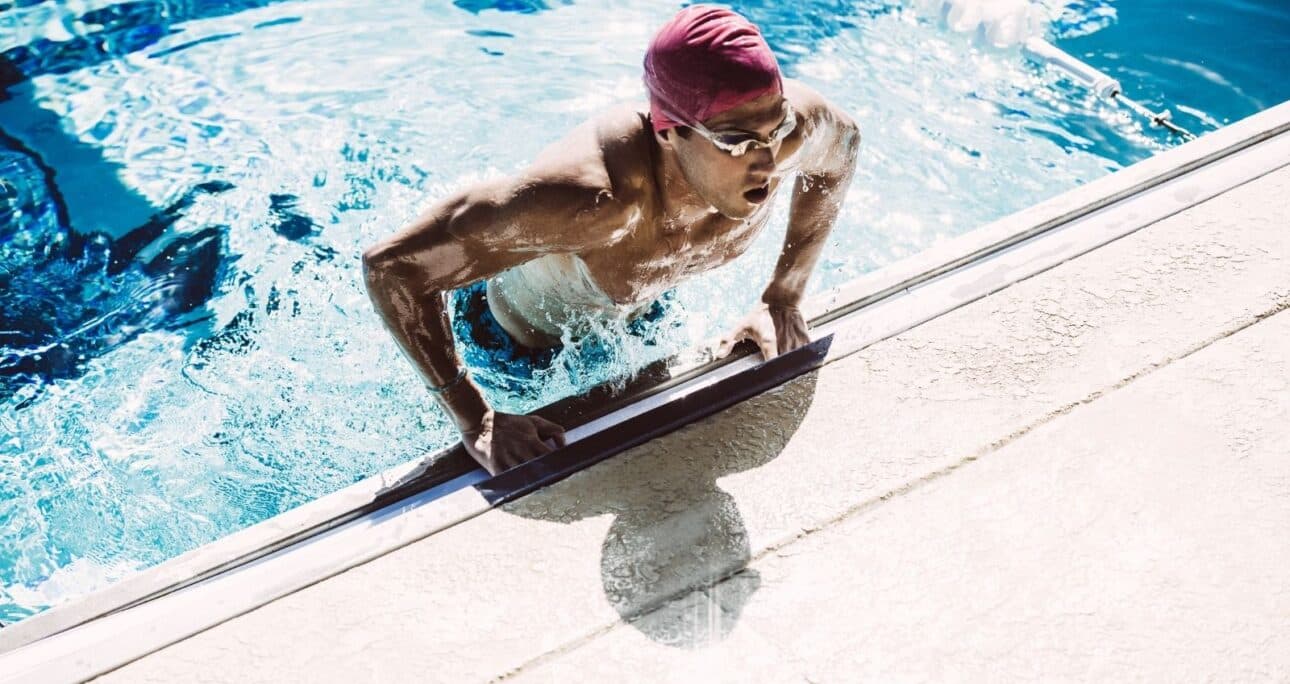
To understand what the feeling of "pinching over water" is like, imagine a very familiar situation: you are trying to climb out of a swimming pool where the edges are higher than your head.
What would you do? Surely you can't just use your fingertips to pull yourself up.
Instead, you'll need to place your hands on the edge of the pool. Most importantly, keep your elbows high and feel the firm connection from your hands through your wrists to your forearms . It is this connection, not just your hands, that forms the true "foundation" from which you can push your entire body upwards.
The "support" motion in freestyle swimming is essentially the same as "finding a support" under the water's surface. You're turning your forearm and hand into a solid flat surface to "support" yourself in the water, preparing to pull your entire body across it.
2. EVF vs. Semi-Catch: Between 'Textbooks' and 'Reality'
If you watch videos analyzing professional athletes, you'll hear a lot about the term EVF (Early Vertical Forearm) . This is the "gold standard" technique, where athletes can raise their forearms vertically at nearly 90 degrees, just like when they press their forearms against the edge of a pool.
However, it requires a very high degree of flexibility and strength. Therefore, for 99% of recreational swimmers, Vi suggests a much more effective and safer technique:
Semi-Catch (Partial Water Bearing) Instead of trying to raise your forearm to a 90-degree angle, you just need to focus on two things:
Always keep your elbows high in the water, close to the surface.
Begin by bending your wrists and elbows so that your hands and forearms start "pointing down towards the bottom of the lake," forming a flat surface.
Simply creating an angle of 120-140 degrees between your upper arm and forearm is already a huge success.
Deadly Mistakes When 'Slapping'
Error 1: Dropped Elbow: Instead of keeping your elbow high to "climb," you let your elbow drop lower than your hand. As a result, you lack support and your hand simply "slips" through the water.
Error 2: Straight-Arm Pull: Completely ignoring the water resistance phase, like trying to straighten your arms to pull yourself up from the edge of the pool – an impossible task.
Practical Corner: From the Pool Wall to the Water Surface
1. The "Pool Push-ups" exercise
Objective: To build strength and register the forearm support posture in muscle memory.
Instructions: Stand in the pool and place both hands on the edge. Using the strength of your arms, shoulders, and chest, slowly push yourself up until you can firmly rest your forearms on the edge of the pool. Hold for 2 seconds, then slowly lower yourself down. Repeat 5-10 times. This is an extremely effective supplementary exercise on land.
2. Exercise: One-Handed Water Support
Objective: To apply the feeling of "climbing the pool wall" to an aquatic environment.
Instructions: Once you've mastered the feel on land, apply it to the water. Extend one arm straight forward as a support, and use the other arm solely for the "water-supporting" motion: keep your elbow high, bend your wrist and elbow to feel the pressure on your forearm. Imagine you're trying to "support" your forearm on an invisible platform underwater.
Advice from Coach Vi (Tips)
“When swimming, always ask yourself: ‘What are my forearms doing?’ Are they participating in creating support, or are they just being passively ‘pulled’ along? Make your forearms work, like when you do pool push-ups!”
Summary & Homework Assignment
In summary: "Water gripping" is the act of creating a stable support with both the forearm and hand, similar to climbing the edge of a pool.
Homework: Next time you swim, spend 5 minutes doing "Pool Push-ups ." Then, get in the water and swim a few slow laps, trying to recreate that feeling of your forearms pressing down underwater. If you want to amplify that feeling, you can wear appropriately sized paddles.
Once the "foundation" is solid, in the next article we'll learn how to use the "winch"—that is, the back and chest muscles—to pull the entire body along. See you in the next article, The 'Pull' !
Wishing you all successful underwater "climbs"!
Sincerely, Coach Pham Thuy Vi