
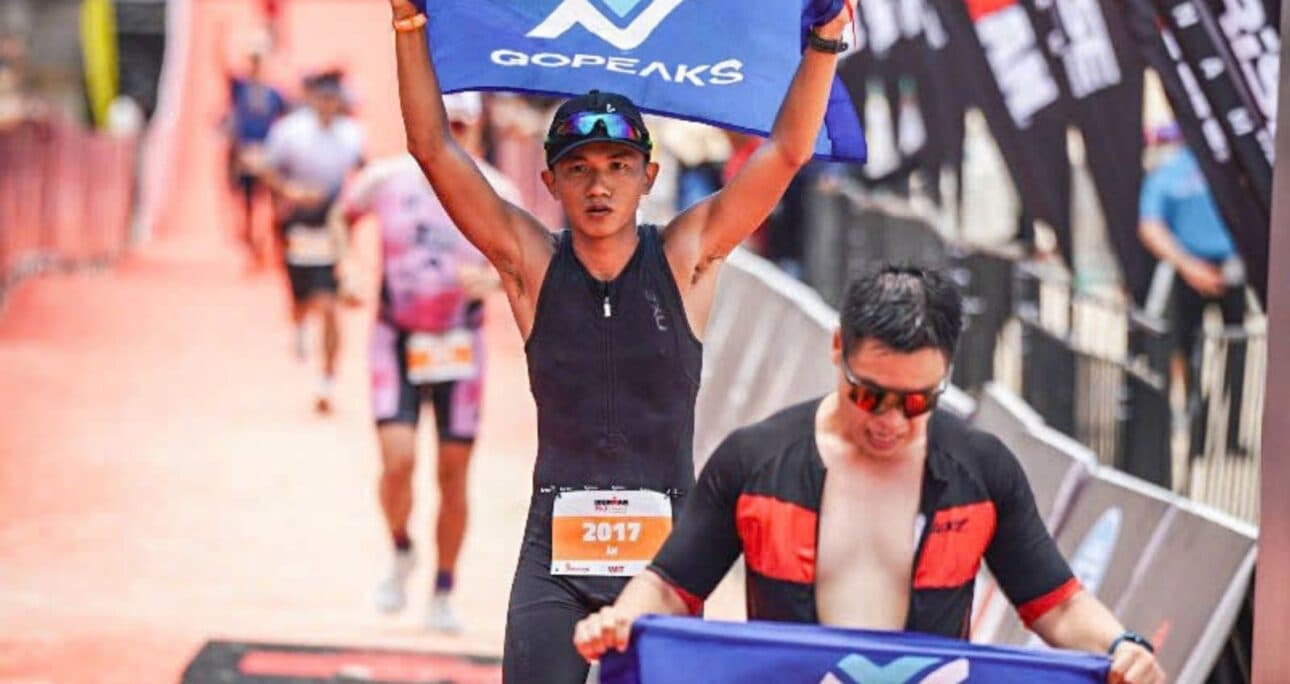
Huynh Ngoc An: 40 Days to Conquer Ironman 70.3 from Scratch
In the world of endurance sports, there are milestones regarded as symbols of relentless discipline—and one of them is conquering Ironman 70.3. This journey is typically measured in years, in thousands of hours of sweat poured onto roads, bikes, and open water. So the question arises: Is it possible to complete Ironman 70.3 starting from zero in just 40 days?
Logic and sports science would say no.
But the story of Huynh Ngoc An, a young man born in 1997, stands as undeniable proof that human limits can sometimes stretch far beyond logic.
This is not merely a story about performance at Ironman 70.3 Da Nang. It is a deep dive into an “impossible” Ironman training plan, the critical role of sports nutrition, and an invisible force capable of shattering all assumptions: WILLPOWER.
Where Do Limits Really Lie? A Story of Willpower and Science
In late March 2025—exactly 40 days before Vietnam’s biggest triathlon event—a thin, slightly timid young man from Cu Chi walked into Gopeaks. His eyes carried an unusual intensity and determination. His name was Huynh Ngoc An. He told us he might have a race slot and wanted to start training.
In the professional coaching world, this request bordered on absurd. Ironman 70.3 consists of 1.9 km open-water swimming, 90 km cycling, and 21.1 km running. It is the culmination of meticulous preparation—not a race you “try just to see.” But we listened.
A “Negative” Starting Point: When Data Tells a Brutal Truth
Before designing any Ironman 70.3 plan, the first task for a coach is to assess the athlete’s foundation. What we saw in Huynh Ngoc An was not just zero—it was below zero.
Swim–Bike–Run Technique: When the First Bricks Don’t Exist
Running:
When asked to run, An leaned forward with his head down and rounded back—a form that was not only inefficient but carried a high risk of injury. He explained, “I was taught to lower my head and push my hips back.” This was a fundamental misconception that had to be dismantled and rebuilt from scratch.
Cycling:
He had never owned a road bike, didn’t know how to use gears, and had no concept of cadence or aerodynamic positioning.
Swimming:
His swimming background was limited to simply “not drowning.” Breathing technique, stroke mechanics, and sighting in open water were completely foreign concepts.
For a beginner triathlete, this list alone would be overwhelming. With only 40 days, it was nearly unthinkable.
Alarming FRC Levels: A Survival-Level Nutrition Challenge
The challenges extended beyond technique. Advanced testing using the PNOE system revealed another harsh truth. Huynh Ngoc An’s FRC (Functional Reserve Capacity) was just 2.9 kJ at a body weight of 47 kg.
To put this simply, FRC is like the last emergency fuel reserve in your tank—the energy your body taps into only in survival situations. Endurance athletes typically have very high FRC values. A level of 2.9 kJ is a red alert, indicating severe depletion and physical frailty.
He was underweight, undernourished, and living irregularly. He didn’t have enough fuel to exist, let alone train.
Every rational instinct as a coach said we should refuse.
But there was one variable that no machine could measure: the determination in his eyes. And Gopeaks decided to bet on that.
The “Impossible” Ironman 70.3 Training Plan: Rewriting the Rulebook in 40 Days
In a case this extreme, traditional training frameworks were put aside. We built a day-by-day adaptive plan, focusing only on the most critical priorities.
Lesson One: “Learn to Eat” Before “Learning to Run”
The top priority wasn’t training volume—it was sports nutrition. Every day began with the same reminder:
“An, eat first. You can’t run if there’s nothing to burn.”
His diet was completely redesigned:
– Complex carbohydrates for sustainable energy
– Adequate protein for recovery and muscle rebuilding
– Healthy fats, vitamins, and minerals
This was the foundational brick upon which everything else depended.
Dissecting Every Session: From Freestyle Technique to Cycling Cadence
An’s program was broken into a series of micro-goals:
Morning sessions:
Focused on freestyle swimming technique—bilateral breathing, arm mechanics, kick efficiency, and pool-based sighting drills. Each session was a battle with water and patience.
Afternoon sessions:
Dedicated to rebuilding running mechanics and introducing cycling fundamentals.
Running:
Instead of long runs, An repeated form drills to retrain muscle memory—upright posture, high hips, foot strike under the center of mass.
Cycling:
The early days were spent on a smart trainer, learning smooth pedal strokes, tolerating saddle discomfort, and understanding gear shifting.
Progress:
Slowly but surely, change appeared. His running form improved, his breathing in the pool stabilized, and he gained confidence controlling the bike. Every small win was acknowledged and reinforced.
The Power of Community: When “Family” Becomes the Best Equipment
One decisive factor no training plan can script is community.
When we learned that An planned to work extra jobs just to survive, the Gopeaks team made a decision: he would stay at the gym. This saved nearly five hours of commuting per day and immersed him fully in training.
From the bike to running shoes to race gear—everything was supported by the Gopeaks “family.” An was not fighting alone. He had mentors, brothers, and teammates reminding him to eat, correcting his form, and—most importantly—believing in him.
Ironman 70.3 Da Nang: Science vs. a Promise from the Heart
As race day approached, performance modeling based on all available data predicted an optimistic finish time of 5:57:52.
Then An calmly said:
“I’ll try to finish sub-5:30—for you, coach.”
We didn’t extinguish that fire.
We used it as fuel.
1.9 km Swim: Conquering the Fear of the Open Sea
An completed the swim safely—his first major victory. He had overcome the psychological barrier of open-water swimming.
90 km Bike: Racing Against Himself
Riding a borrowed bike, without an expensive power meter, An relied solely on feel and discipline. He held steady, resisted the urge to chase others, and executed the nutrition strategy flawlessly.
21.1 km Run: When Cheers Become Commands
This was the ultimate test of will. Gopeaks members were stationed along the course. Every time An passed, we shouted:
“An! Faster!”
Those shouts weren’t encouragement—they were orders fueled by belief. Each time, his stride grew stronger. He was running on something beyond physical energy.
5:54:13 – A Number That Honors Willpower
At the finish line, the clock read:
AN HUYNH NGOC – 5:54:13
Just three minutes off the scientific prediction—but far beyond logical expectation. A man who started from below zero, armed with nothing but trust and perseverance, had become an Ironman.
Huynh Ngoc An’s story is more than a successful case study. It is a lesson for all of us—especially beginners dreaming of Ironman 70.3:
Don’t let your starting point define you. The greatest limits exist in the mind, not circumstances.
Trust science and process. Data-driven training maximizes every effort—especially for beginners.
Seek companionship. No great journey is completed alone. Community can create miracles.
If a frail young man with just 40 days of preparation could achieve this, what excuse do the rest of us have to abandon our dreams?
Your journey may not be Ironman—but the will to conquer it is already within you.