
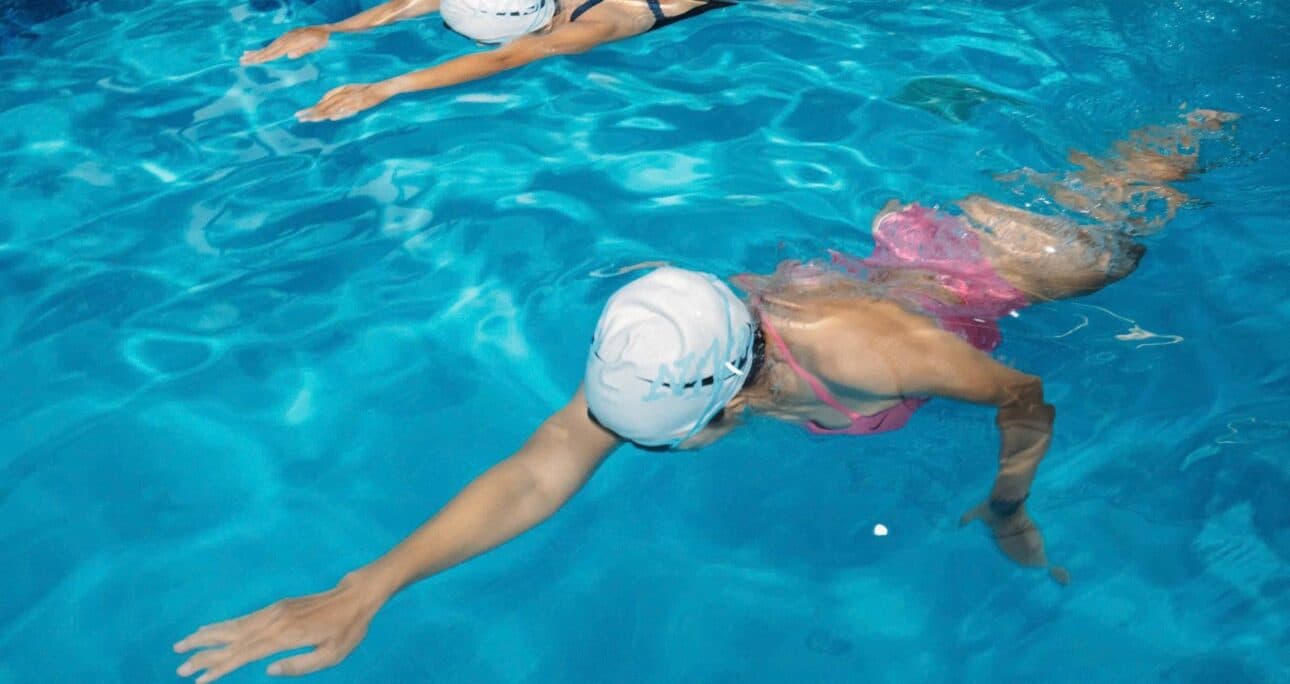
Learn Freestyle Swimming from the Fundamentals: The 'Pull' Technique – Using only your arms isn't enough.
Welcome back to the "Learning the Freestyle Swim Correctly from the Ground Up" series!
In the previous lesson, we learned how to "anchor" and create a stable "platform" using the "water-support" technique. Today, we will learn how to attach a "winch" to that anchor to pull your entire body forward.
This is the Pull phase – the stage that generates the most propulsion, the heart of the freestyle swimming cycle. Many people, despite being strong, don't swim fast because they're trying to "pull" using only the strength of their arms, instead of utilizing the "giant" muscle groups in their torso and chest. Let's join coach Vishark in "awakening" these giants!
Learning Objectives
After reading this article, you will:
Identifying the major muscle groups (Obsculus, Chest) as the primary power source for the pull phase.
Understanding the proper movement of the hand underwater is key to effective technique in modern engineering.
Understand the timing of the connection between the pull and the hip rotation.
"Dissecting" the Technology: Activating the 'Wire Winch Motor'
1. The synergy of multiple muscle groups
Pulling water isn't just the work of the arms; it's a coordinated effort involving three major muscle groups: the latissimus dorsi (Lats) , the pectoralis major (Pecs) , and the supporting muscles of the deltoids (Shoulders) .
Think of your latissimus dorsi (or pectoral muscles) and pectoral muscles as two incredibly strong "ropes" connecting your torso to your arms. Your task is to learn how to "tighten" these two ropes to pull, instead of just using your biceps. When you feel soreness in your underarms and sides after swimming, that's a sign you've activated the right "engine."
2. The Path of the Hand Underwater – 'S-line' or 'Straight Line'?
The old (S-line) view: Previously, it was believed that the S-shaped path of the hand underwater would help to draw in more water.
Modern technique: Today, analysis has shown that a nearly straight-ish back path is the most efficient. It allows you to apply thrust to the rear directly and continuously.
Coach Vi's advice: Don't try to draw a complicated S-shape. Instead, imagine you're a train, and there are two straight, parallel tracks running directly beneath you at the bottom of the lake.
Your task is simple: keep your fingertips moving along that track , pulling straight backward. Your hand will automatically follow a gentle and natural curve, but the overall direction will always be a straight line.
3. The Golden Timing: When Will the 'Hip Conductor' Make His Move?
This is a technical detail that I only share with my students:
During the initial phase of the pull, when you're using your big toe muscles to pull, your hips are almost "locked" in place, allowing your core muscles to tighten, providing maximum stability for the "support platform".
The powerful hip rotation only truly occurs at the end of the pull phase , just as your hands are about to transition to the push phase. This rotation is like a final "jerk" to amplify the force and propel your body forward.
Common Mistakes When 'Pulling'
Error 1: Pulling with your arms, not your sides and chest: You feel exhausted in your shoulders and biceps, but you're not swimming fast. This is a sign you haven't activated the "winch motor."
Error 2: Pulling your arms diagonally across the center axis: This violates the "axis plane" learned in Lesson 1. This action not only causes you to swerve but also negates effective pulling force.
Practical Corner: Awakening the 'Giant'
1. Land-based exercise: Resistance Bands
Objective: To simulate the motion of pulling water and activate the latissimus dorsi and pectoral muscles.
Instructions: Stand and bend forward, keeping your elbows high, and focus on the feeling of "squeezing" your latissimus dorsi and chest muscles to pull the rope towards your hips.
2. Underwater exercise: One-Arm Drill
Objective: Focus 100% on feeling the pulling motion of the active hand.
Instructions: Extend the non-fan arm straight forward. Perform a complete arm swing with the other arm. Feel the connection between your hand and your latissimus dorsi and chest muscles.
Advice from Coach Vi (Tips)
Feeling your latissimus dorsi (lats) can be quite difficult for beginners. There's another muscle group that's much easier to feel and is also a "giant" in your pull: the pectoralis major (chest muscle).
Try this trick right on land: Stand straight, extend one arm above your head as if preparing to pull in the water. Place your other hand on the pectoral muscles of the extended arm. Now, press down on the water and actively "tighten" (contract) your pectoral muscles . You will clearly feel them "moving," contracting, and working. That's the feeling you need to find and recreate when pulling in the water!
Summary & Homework Assignment
Summary: The pull phase is powered by the oblique and chest muscles, not the arms. Pull almost straight back and connect it with a hip rotation at the end of the phase.
Homework: Next time you swim, try the One-Arm Swim exercise. Feel if your latissimus dorsi and pectoral muscles are working, or if only your arm is aching.
I hope you find that feeling of your muscles working together!
Sincerely, Coach Visark