
History of Triathlon – Part VI: The Digital Era of Super Athletes and the Future of Triathlon
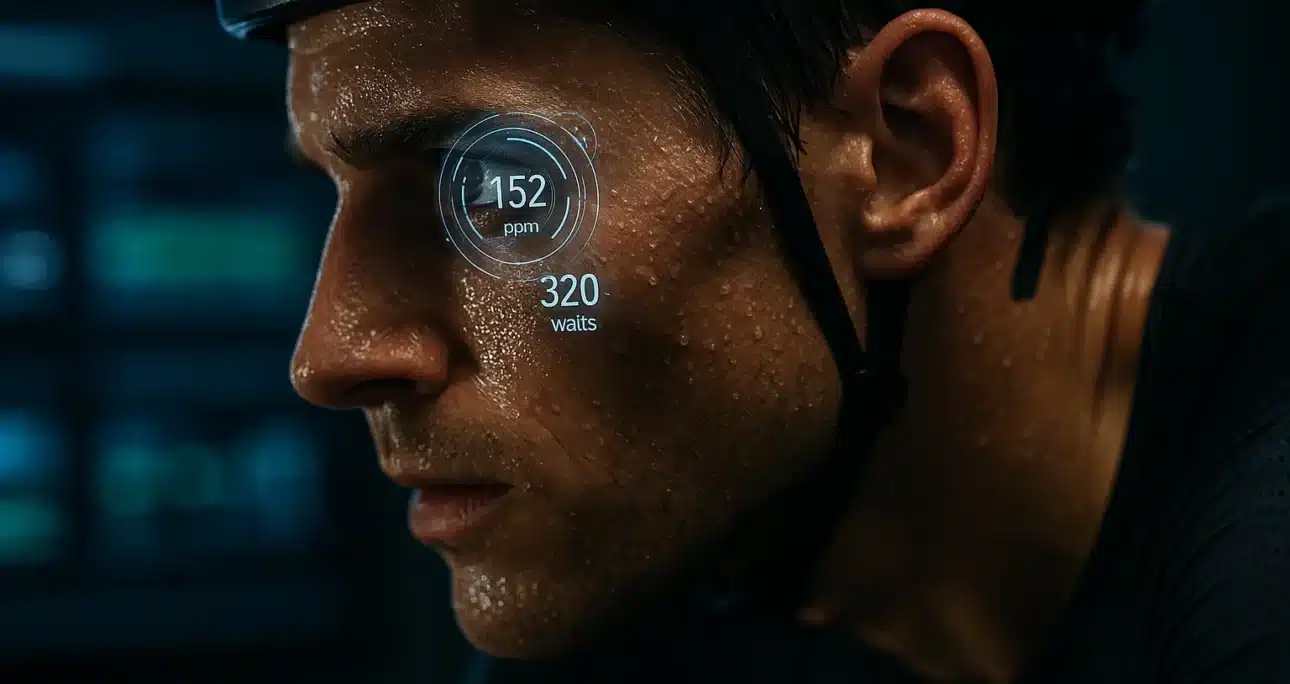
Imagine a triathlete today. He doesn’t just have a bike and running shoes. He is a mobile data center. A power meter analyzing every watt of output. A GPS watch tracking every heartbeat, cadence, and speed. A core temperature sensor warning him when he overheats. A continuous glucose monitor (CGM) telling him precisely when to refuel.
In his “pain cave” at home, he can race against thousands of others worldwide in a virtual competition. Every training session is recorded, analyzed, and optimized to the tiniest detail.
Compare that to Gordon Haller, the first Ironman winner, who only had a Timex watch and a support crew handing him… beer.
The contrast shows just how far triathlon has come. The modern era is no longer merely a battle of will against nature. It is the pinnacle intersection of human spirit and technological precision. This is the story of the Digital Era, the rise of the Super Athlete, and a future we are only beginning to touch.
The Athlete 2.0 – The Birth of the Super Athlete
The 21st century has seen the rise of a new generation of athletes, equipped with tools that the pioneers could only dream of.
The Data Revolution
Training is no longer based solely on feel—it is based on science. Metrics like FTP, CTL, HRV, W/kg have become a universal language. Platforms like TrainingPeaks turn every amateur athlete into a scientist of their own body. Technology has democratized high-level training, allowing anyone—not just professionals—to train smarter and more efficiently than ever before.
Conquering the Impossible: Sub7/Sub8 (2022)
If Breaking2 was marathon history, then Sub7/Sub8 is triathlon’s answer. For years, completing a full Ironman in under 7 hours (men) or 8 hours (women) was considered impossible.
In June 2022, a special event in Germany changed that. With the support of a full scientific team, professional pacers, and cutting-edge technology, four of the world’s top athletes shattered those barriers. Kristian Blummenfelt and Joe Skipper broke 7 hours. Katrina Matthews and Nicola Spirig surpassed 8 hours.
Sub7/Sub8 was not a typical race. It was a laboratory, a statement on human potential when every variable is optimized. It raised the standard and opened a new chapter in what is possible in endurance sports.
Spirit Beyond Limits: Paratriathlon at the Paralympics (2016)
But “super athletes” are not defined solely by numbers. In 2016, Rio de Janeiro, the world witnessed one of the most inspiring stories as Paratriathlon debuted at the Paralympics.
Visually impaired athletes swam with guides. Athletes with limb impairments cycled with handbikes or ran with prosthetics. Each had a story, a challenge, but all shared an iron will. They weren’t just competing—they were redefining human strength. The inclusion of Paratriathlon on the world stage proved that the soul of triathlon—the spirit of overcoming adversity—has no limits.
The Media Revolution and Athlete Empowerment
The modern era has also brought profound changes in how triathlon is organized and consumed.
The Ratings Battle: Super League Triathlon
Tired of multi-hour races difficult to follow on TV, a new model emerged: Super League Triathlon. With ultra-short distances, repetitive laps, and dramatic elimination rules, Super League transformed triathlon into a high-speed entertainment sport, akin to Formula 1 or T20 cricket. Events like Arena Games, combining real swimming with virtual bike/run on Zwift, created a unique hybrid format, attracting a new generation of viewers.
Athletes Strike Back: The Birth of PTO
For years, professional athletes felt like “actors” in a show controlled by large organizers, without fair rewards. To change that, the Professional Triathletes Organisation (PTO) was founded.
Backed by strong financial support, PTO created its own competition circuit with massive prize purses, including the Collins Cup (team-based, Ryder Cup-style) and the prestigious T100 World Tour. PTO not only gave professional athletes a voice and rights but also created real competition with the Ironman system, promising a more exciting future for elite triathlon.
Changing Immutable Icons
Even long-standing traditions must adapt to the new era.
Team Explosion: Mixed Relay at the Olympics
At Tokyo 2020 (held 2021), the Mixed Relay debuted. Each team consists of 2 men and 2 women, each completing a short triathlon before passing the baton. The format is fast, dramatic, and highly team-oriented, immediately becoming a fan favorite.
Kona Is No Longer the Only Stage
For over 40 years, Kona, Hawaii was the sacred home of the Ironman World Championship. But COVID-19 and logistical pressures triggered a seismic shift. For the first time, the 2021 Ironman World Championship moved to St. George, Utah.
An even bigger change was announced: starting 2023, the World Championship will alternate between Kona (Hawaii) and Nice (France), with separate race days for men and women. Controversial, yes—but it shows that even the most sacred symbols of triathlon must evolve in a changing world.
Conclusion: The Future of Triathlon – Writing the Next Epic
What does the future of triathlon look like? The modern era offers a glimpse: smarter with technology and data at its core; more engaging with new race formats; and increasingly athlete-driven, with their voices growing louder.
Looking back at 50 years of history, it’s astonishing that it all started with 46 people and a $1 entry fee at Mission Bay. From a “fun run,” it has grown into a global phenomenon, a billion-dollar industry, a laboratory of human limits.
At Gopeaks, we believe that technology, money, and race formats may change—but one thing will never change: the soul of triathlon. The human heart. The will to keep going when the body screams to stop. The pure joy of crossing the finish line, no matter the result. The journey of self-mastery and discovering your strongest self.
The Epic of Triathlon is far from over. A new chapter, full of promise and uncertainty, has just begun. And all of us—from world champions to beginners—are part of the story, writing its next pages together.