
Triathlon Empires – Part IV: Super League – The Revolution That Brought Triathlon to Your Screen
Imagine Two Scenes
The first scene: a lone Ironman athlete, hours away from the finish line, battling a harsh crosswind along a seemingly endless road stretching across a lava field. It’s an epic of endurance, a story of self-conquest, an inner pilgrimage.
Now, picture the second scene: 10 athletes sprinting like arrows in a brightly lit stadium. They’ve just finished the swim, jumped on their bikes in an instant, and are furiously racing in an event lasting only a few minutes before elimination. The crowd roars. Cameras track every movement. Heart rates and power metrics flash on the screen in real time. This is not a pilgrimage. This is a blockbuster action movie.
Both scenes are triathlon. And the existence of the second scene is thanks to a revolution, a new “empire” daring to ask a bold question: in a sport defined by endurance, what if the ultimate goal was entertainment?
This is the story of Super League Triathlon (SLT), an ambitious project that shattered traditional rules to repackage triathlon into a fast, intense, and highly TV-friendly professional league.
The Context: A “Thirst” from the Audience
By the mid-2010s, professional triathlon was at a crossroads. Despite incredible athletes, the sport struggled to capture a mainstream audience.
Long-distance races (Ironman, Challenge): Inspirational stories, but too long and spread out for live TV. Spectators couldn’t follow 8–10 hours of continuous action.
Olympic-distance races (World Triathlon): More dramatic, but tactics often predictable: large bike packs and races typically decided in the final 10 km run.
The community felt that triathlon’s entertainment potential was untapped. The sport lacked a true “league” format where the world’s best athletes could face off continuously, creating stories, rivalries, and easily digestible dramatic moments.
From this “thirst,” an idea was born. Belgian entrepreneur Michael D’hulst, investor Leonid Boguslavsky, and triathlon legend Chris “Macca” McCormack came together. Their vision was clear: create the “peak of triathlon” – not just for athletes, but for fans.
Breaking All the Rules – The DNA of Super League
The first Super League event, held on Hamilton Island, Australia, in 2017, immediately shook the triathlon world. Everything was different. All traditional rules were broken.
Chapter 1: “Hellish” Formats
Instead of a single long race, SLT is a series of ultra-short races with minimal rest. Intensity and pressure are maximized. Their race formats quickly became legendary:
Triple Mix: Three mini-triathlons, with the order of disciplines shuffled (e.g., Swim-Bike-Run, Run-Bike-Swim, Bike-Swim-Run). Tests athletes’ adaptability.
Enduro: Multiple mini-triathlons in a row with no rest. Athletes finishing last in each stage are eliminated. A brutal survival battle.
Eliminator: Three mini-triathlons with 10-minute breaks. After Rounds 1 and 2, the last-place athletes are eliminated, leaving a small group for the final round.
These formats turn each race into a knockout series where every second, every transition, can decide survival.
Chapter 2: “Gamification” – Turning Races into a Game
SLT incorporates video game elements to increase strategy and drama:
Short Chutes: Athletes earn a “short chute” – a shortcut – if they win a discipline or stage. Deciding when to use it can completely change the race.
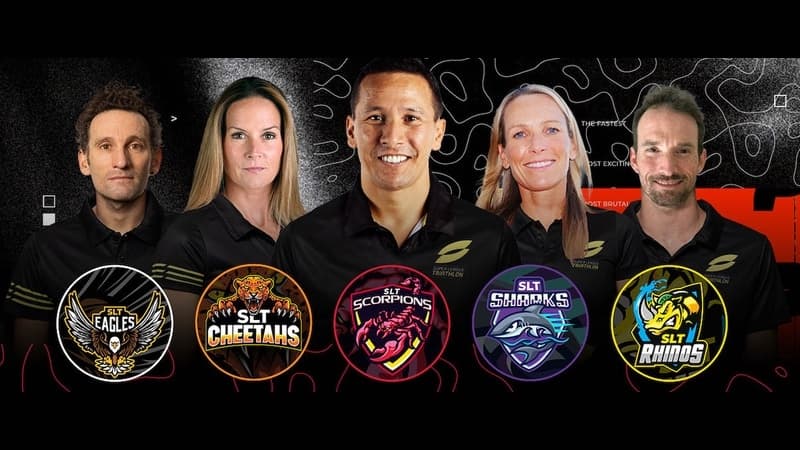
Team Colors & Franchises: Athletes compete not only individually but also as part of teams wearing distinctive trisuits, adding a team competition layer and making it easier for fans to follow and support.
Chapter 3: The Playground of Stars
Super League is a closed league for the world’s best professional athletes, mainly Olympic and World Champions. Familiar names like Jonathan Brownlee, Vincent Luis, Hayden Wilde, Flora Duffy, Georgia Taylor-Brown regularly compete. This ensures every race is a top-level showcase.
Conquering the Virtual World – The Arena Games Revolution
In 2020, when COVID-19 halted live sports, Super League innovated: Arena Games, a unique hybrid format:
Swimming: Athletes swim in a standard 50m Olympic pool.
Cycling & Running: Immediately after swimming, they jump onto indoor smart trainers and curved treadmills. Their real-world effort powers avatars racing virtually on Zwift, displayed on giant LED screens.
Combining real-world effort and virtual racing creates a perfect entertainment product. It can be held anywhere, indoors, without weather dependency. Every move is visible to fans and cameras, with athlete metrics displayed in real time – turning the race into a live eSports experience.
Arena Games became so successful that World Triathlon partnered with SLT to establish it as the official Esports Triathlon World Championship, legitimizing an entirely new race format.
Conclusion: Is the Future of Triathlon Entertainment?
Super League Triathlon raises an intriguing question for the sport’s future. It proves that triathlon can be highly entertaining for a mass audience. SLT has brought new revenue, sponsors, and a dynamic, modern image to triathlon.
But it also sparks debate: is this the future of triathlon, or just a separate “branch,” a show alongside traditional endurance challenges? Does focusing too much on entertainment risk losing triathlon’s core soul – the internal struggle and personal journey of self-conquest?
At Gopeaks, we believe the answer is not “either/or.” Super League does not replace the epic journey of an amateur athlete striving to complete their first Ironman 70.3. They are parallel worlds that complement each other.
Super League is a necessary “empire.” It shines, grabs attention, and turns athletes into superstars. And the stories and top-level performances of these superstars inspire the entire community – from fans glued to TV screens to Gopeaks athletes training toward their own finish lines, anywhere, at any distance.