
Learn Freestyle Swimming from the Fundamentals: Your Head Is the Steering Wheel – The Remote Controlling Your Hips
Hello everyone, Vi aka Vishark is back again!
We have already covered two foundational articles together. In Article 1 , we established the "framework" of the 3H Axis. In Article 2 , we clearly defined the "tasks" for each department within the "body company".
Today, we'll delve into the "job description" of the most powerful boss, the one who can decide the success or failure of the entire company: the Control & Steering Committee – THE HEAD.
Why did Vi dedicate an entire article to talking about the head? Because 90% of those who swim with their torso sinking originate from here. Solving the head problem solves half the problem with freestyle swimming. It's like a remote control for your hips. Press the "lift" button, and your hips will sink. Press the "lower" button, and your hips will float. It's that simple to correct the hip sinking problem in most cases.
Technical Analysis: The Role of the "Steering Wheel"
1. Seesaw Effect
Think back to the seesaw at the park. Your body in the water functions exactly the same way. The two ends of the seesaw are your head on one side and your hips and legs on the other (where the bones and muscles are denser and therefore heavier).
The laws of physics are immutable: Head up → Hips sink down. Period. When you try to lift your head to look ahead, you are actually sinking your lower body to the bottom of the lake.
2. Four Golden Criteria for Top Position
To ensure the "steering wheel" functions correctly, make sure of the following four criteria:
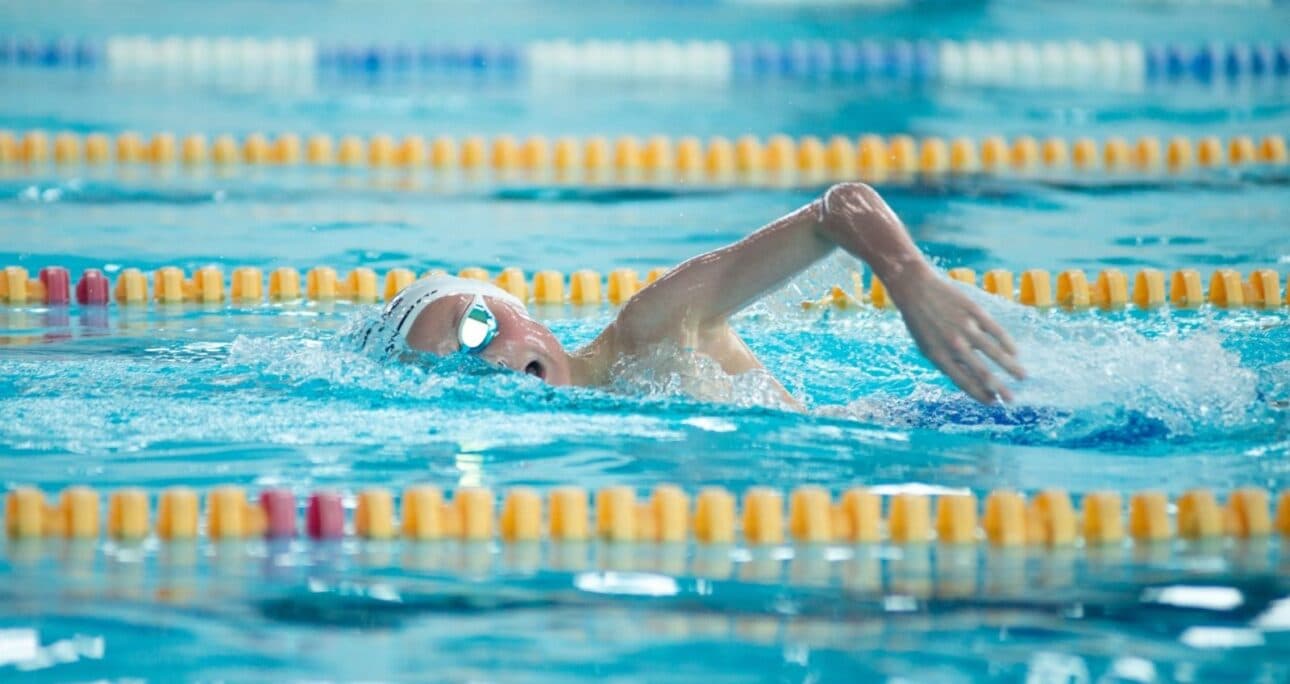
Gaze: Look straight down at the bottom of the lake, or only slightly angled forward. Absolutely do not look at the edge of the lake ahead.
The crown of the head: Always the highest point and pointing straight ahead like an arrow. It is the locomotive, pulling the entire body forward.
Neck and nape: They should be aligned with the spine, forming a straight line. Feel your neck stretching out in a relaxed way, without bending or tensing.
Water Level: The clearest indicator. The water will be just above your hairline. You'll feel the back of your neck slightly exposed above the water's surface. It's a very satisfying feeling and a sign you've done it right.
Classic Mistakes and Their Chain Reaction Consequences
There are many mistakes regarding head position, but they all stem from one fundamental error: looking straight ahead.
Let's look at the disastrous chain reaction it caused:
Head raised → Neck tilted back → Back arched → Hips sinking → Legs sinking → Creates enormous drag.
As a result, you're swimming "uphill" and have to use a brake. No wonder you're out of breath after just a few dozen meters!
Solution: Imagine a tennis ball placed between your chin and chest, holding you in place while swimming so it doesn't fall off.
Practical Corner: “Brainwashing” Old Habits
To correct a bad habit, we need to reprogram our bodies to feel. Try these two simple exercises:
1. Exercise: The 'Downhill Feeling'
Objective: To find a natural sensation of "chest pressure and hip protrusion."
Instructions: Stand at the edge of the pool, take a deep breath, then push off the wall and glide in Superman/streamline position. While gliding, do absolutely nothing, focusing on one thing only: actively pressing your chest and shoulders slightly down into the water. Imagine you're sliding down an invisible slope; you'll immediately feel your hips and legs automatically rising slightly. Then you can gently kick your legs to prolong that sensation.
2. Exercise: 'Head Lock' with Snorkel
Objective: To completely eliminate the breathing factor in order to focus 100% on head stability.
Instructions: If you have a snorkel, put it on. Extend both arms straight. Begin swimming gently. Now, imagine you are a train with a straight track at the bottom of the lake. Your eyes should always look straight ahead and move precisely on that track, without glancing sideways.
Advice from Coach Vi
"Water is your friend; trust it. Instead of straining your head, 'place' your head on an invisible 'water pillow' and relax your neck. When you find the right balance, the water will support you."
Summary & Homework Assignment
In summary: The head is the rudder, eyes look down at the bottom of the lake (perhaps slightly tilted forward), keeping the head stable as part of the axis, and seeking the feeling of "sliding downhill".
Homework: Next time you swim, spend the first 5 minutes just gliding and practicing the 'Glide Feel' exercise. Repeat this many times until you can easily recreate that feeling.
We hope you find your own "water pillow"!