

Smart Load Management: The Art of Turning Sweat into Performance
In the world of endurance sports, these aren't just jargon for professionals. These are two core elements, the DNA that determines whether you'll become a phenomenal athlete or remain perpetually stuck in a rut.
Mastering Load Management is the art of transforming sweat into performance. Understanding Intensity is key to maximizing the value of every hour of training.
But before mastering this art, you've probably experienced a very familiar image: gritting your teeth with each rotation, drenched in sweat, the clock recording hours of exertion. You're working hard, very hard. But deep down, a question keeps tormenting you: "Why am I working out so much, yet still stuck in the same place?"
It's the story of "burning through energy" in the dark.
This article is the map, the compass that Gopeaks wants to give you. Together, we will learn a new language – the language of your own body, starting with mastering Intensity and Load Management.
Three Golden Keys to Unlocking Self-Understanding
To begin a dialogue with your body, you need to learn three core "vocabulary words." These aren't dry terms; they are three keys to unlocking your journey.
FTP (Functional Threshold Power): Think of your FTP as the “zero” mark on your map. It’s the highest intensity you can sustain for an hour. Everything you do, from gentle to explosive, will be measured against this reference point. Knowing your FTP is the first key you have in your hands.
TSS (Training Stress Score) – The “Score” of Effort: Did you know that an hour of relaxed cycling is completely different from an hour of intermittent interval cycling? TSS is how we quantify that difference. It assigns a stress “score” to each training session. At Gopeaks, your training plan is built on your weekly TSS goal, not the number of hours you put in. We pursue quality , not quantity.
CTL (Chronic Training Load) – Your Fitness Account: CTL is a measure of the fitness level you've built over the past six weeks. Imagine it like a bank account. Each training session with a TSS score is like "depositing money" into it. Is your CTL increasing steadily and consistently? Great, you're getting richer in fitness. Is your CTL skyrocketing suddenly? Be careful, that's a sign of a risky investment that could lead to bankruptcy due to injury or exhaustion.
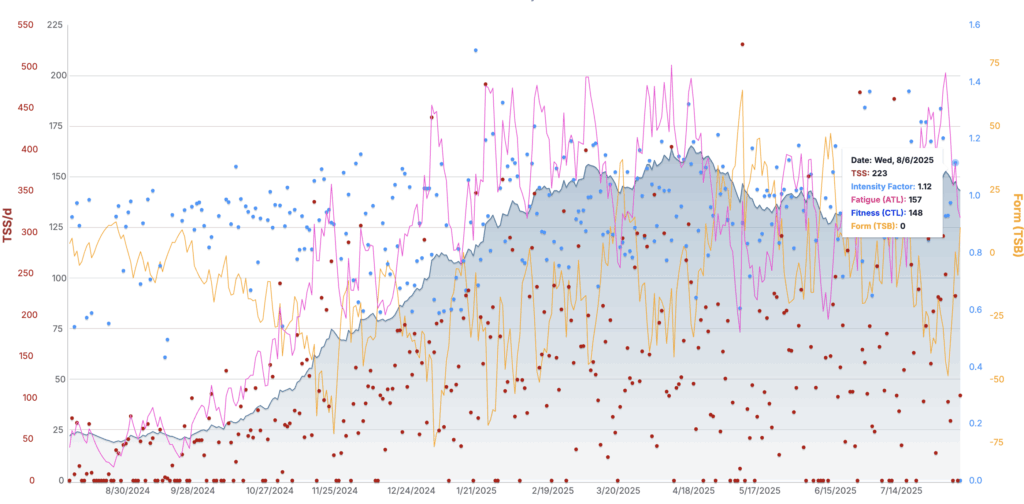
Symphony of Intensity Zones
Once we have the language, we begin to conduct an orchestra. Each intensity zone is a group of instruments, and an effective rehearsal is a symphony, not a chaotic jumble of sounds.
Zones 1-2 (Resilient Foundation): These are the "hardworking laborers" in your orchestra. They play the low notes, building a solid foundation for the entire symphony. In the Polarized 80/20 model, they are the unsung heroes, accounting for 80% of the time, helping you go further and recover faster.
Zone 3 (The Middle Threshold): This is the "sweet trap." It's challenging enough to tire you out, but not challenging enough to create breakthrough adaptations. Many people get stuck here, feeling like they've been "training hard" but without achieving significant results.
Zones 4-5 (Elite Squad): These are the trumpets and the pounding drums. They are the "elite squad," appearing only 20% of the time for high-intensity, short-duration missions to push boundaries and achieve peak performance.
At Gopeaks, we are the conductors. We help you decide when to use the low notes of Zone 2 and when to unleash the explosive energy of Zone 5, to create your own symphony of vocal prowess.
The Rhythm of Progress: “Rest to Become Stronger”
An architect doesn't build continuously. They have phases of laying the foundation, building the floors, and finishing. Your body is the same.
Cycle 3-1 (3 weeks Build – 1 week Deload): We climb the mountain for 3 weeks, pushing CTL and TSS to high levels. Then we spend 1 week at the “rest station” (Deload), reducing the load so that the body can absorb all the results, heal, and become stronger for the next leg of the climb.
For Masters athletes (older): Their bodies are intelligent machines, requiring more time to adapt. Therefore, we apply a 2-1 rhythm (2 weeks of build-up – 1 week of deloading). They are the ones who best understand the philosophy: "Rest is not giving up, it's part of the strategy."
Data is the map, but you are the explorer.
The numbers on TrainingPeaks are a guide, but they don't tell the whole story. "This week has been very stressful for me." "I didn't sleep well last night." "I feel like my body isn't ready."
That's when the dialogue between coaches and students at Gopeaks becomes more valuable than any algorithm. Data tells us what you can do. Your feelings tell us what you should do.
We don't train robots. We work alongside people.
Your journey from a "blindly exhausting" athlete to a "master of form" begins here. It starts with understanding, with asking "Why?" before each training session, and with believing that peak performance doesn't come from recklessness, but from a smart approach.
No Pain – No Peak. But pain needs a purpose. And a peak needs a path.