

Sports Injury Prevention – Volume 1: RFD
What is an RFD?
In previous articles, we discussed two types of sports injuries: overuse injuries and acute injuries . Now, we will talk about something that helps minimize and prevent these types of injuries.
When it comes to athletic qualities, most people immediately think of maximum strength or endurance. But there's an often overlooked indicator that plays a crucial role in injury prevention and performance enhancement : Rate of Force Development (RFD) , also known as the speed of force generation .
Simply put:
Max strength = how much force you can generate.
RFD = how fast you generate that force .
For example:
A person can squat 200kg but needs only 2 seconds to push themselves up.
One person squats 150kg in just 0.2 seconds.
In sports, the second person is usually safer and more efficient because their body reacts faster to unexpected situations.
Why is RFD important in preventing sports injuries?
In sports—from running, jumping, soccer, tennis, basketball to martial arts—injuries often occur when the body doesn't have enough time to generate force to stabilize the joints or absorb the impact .
1. Stabilize the joint during contact and change of direction.
Each time the foot touches the ground or the body changes direction, the muscles, tendons, and ligaments must exert extremely rapid force to maintain stability.
If RFD is low → muscle response is slow → the entire load is concentrated on the ligaments and joints.
This is a common cause of anterior cruciate ligament (ACL) tears, ankle sprains, or knee pain .
2. Reduce the risk of injury from collisions.
In sports collisions, individuals with high RFD can immediately contract and stabilize their muscles to protect their spine, shoulders, and hip joints.
Conversely, low RFD means the muscles don't have time to contract, so the impact force is transmitted directly to the bone and cartilage.
3. Reduce injuries caused by slow reflexes.
When experiencing a fall, collision, or loss of balance, RFD helps the body generate force quickly to regain balance .
People with low RFD are more prone to serious falls, fractures, or soft tissue injuries .
4. Protecting older athletes
Age reduces strength, but RFD decreases much faster .
This is why middle-aged and older people are more prone to falls or injuries in sports.
RFD training is a key measure to prevent sports accidents at all ages.
Physiological mechanism: How does RFD work?
To understand why RFD directly affects injury, we need to look at the physiological mechanisms:
The central nervous system (brain and spinal cord) must activate hundreds of thousands of muscle fibers simultaneously and extremely quickly .
Motor neurons need to generate signals at a high frequency and in a synchronized manner.
Tendons and connective tissue must be elastic to absorb and transmit force.
Proprioception helps the body know the position of the joint and adjust the force immediately.
If any link is weak (nerve, muscle, tendon, proprioception), RFD will be low → increased risk of injury.
RFD and the difference between maximum power – two things that are often confused.
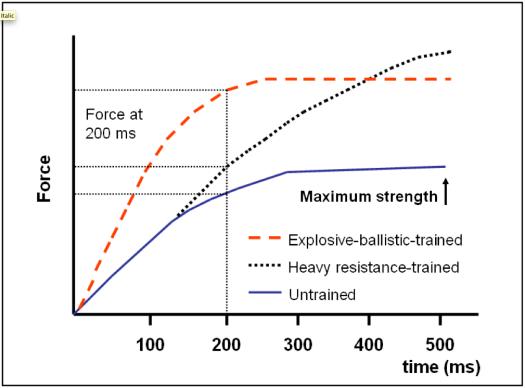
Those who train explosively (explosive-ballistic) generate more power in the first 200 milliseconds, while the non-training group generates power the slowest. Source: fitforgolf.blog
Element | Max Strength | RFD (Speed of Force Delivery) |
|---|---|---|
Define | Maximum total force that can be generated | Force generated for a short period of time (0.1–0.3 seconds) |
Relate to | Muscle size, muscle contraction ability | Nervous system, reflexes, tendon elasticity |
Application | Weightlifting, powerlifting, heavy lifting | Contact sports, football, running, jumping, injury prevention. |
Limit | Does not reflect reaction speed | Does not demonstrate sustained maximum strength. |
Therefore, an athlete may be strong (lifting heavy weights) but still prone to injury if their RFD is low .
Exercises to improve RFD and prevent injury.
To increase RFD, you can't just lift heavy weights. You need explosive, high-speed exercises that stimulate the nervous system.
1. Plyometric Training
For example: jump squat, bounding, pogo hops, depth jump.
Benefits: Improves reflexes upon landing, protects the knee joint and Achilles tendon.
2. Olympic Lifts
Examples: clean, snatch, push press.
Effect: Trains almost instantaneous full-body power generation – extremely useful in basketball, soccer, and martial arts.
3. Isometric Explosive
For example: pushing a blocked weight in a rack with maximum force for 3–5 seconds.
Effect: Improves the ability to quickly mobilize muscle fibers without causing joint strain.
4. Speed Strength Training
For example: squats, bench presses, and deadlifts at 60–70% of 1RM, focusing on lifting speed.
Effect: Helps the body learn to "move fast" instead of just "lift heavy," reducing the risk of injury when changing direction or in collisions.
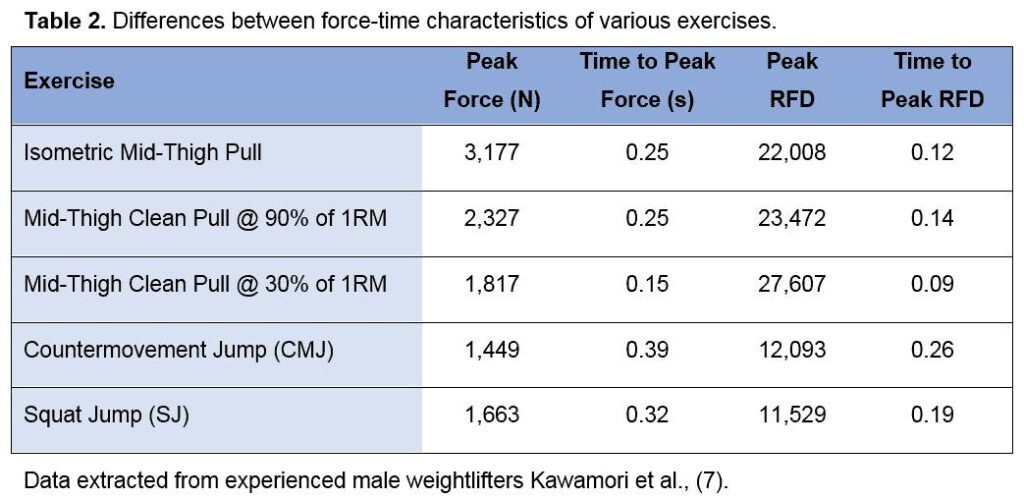
Different exercises generate different levels of force and force-generating speed, with mid-thigh clean pulls producing higher RFD than squat jumps and countermovement jumps. Source: scienceforsport.com
Conclude
Rate of Force Development (RFD) is not just a physiological indicator, but also a vital factor in preventing sports injuries .
High RFD = rapid response, joint stability, shock reduction, injury limitation.
Low RFD = slow muscle response, poor stress on tendons and joints, high risk of injury.
Therefore, if your goal is not only to be stronger but also safer , incorporate RFD- developing exercises into your training program.