
History of Triathlon – Part II: Mission Bay 1974 – The Fun Run That Wrote History
September, 1974.
The sky over San Diego was crystal clear. Golden sunlight poured like honey over the shores of Mission Bay, sparkling like fragments of a shattered dream. There were no grand gates, no packed grandstands, no booming announcer’s voice over loudspeakers. There was only the gentle sound of waves lapping against the sand, the laughter and chatter of a group of friends, and one casual question that would go on to change the history of modern sport.
In that peaceful atmosphere, no one—not even those directly involved—could have imagined that they were standing at the epicenter of a Big Bang. An explosion that would create an entirely new universe of limits, willpower, and endurance. A universe called Triathlon.
This is not a story about highly paid champions or grand business plans. This is the story of 46 people, one dollar, and a sunny afternoon that accidentally planted the seed for one of the most demanding and inspiring sports on the planet.
Background: “The Thirst” in the Golden Age of Running
To understand why triathlon was born in 1974, we must look at the American sports landscape of that era. The 1970s were the time of “The Running Boom.” Frank Shorter’s dramatic and historic victory in the marathon at the 1972 Munich Olympics ignited a nationwide passion for running. Thousands of people—from office workers to housewives, people who had never thought of themselves as “athletes”—laced up their shoes and hit the streets.
Running was no longer just a sport; it became a lifestyle, a symbol of freedom, personal health, and self-mastery. Track clubs sprang up everywhere, becoming the centers of social life. One of the most active among them was the San Diego Track Club.
But for the pioneers—those restless spirits always searching for new challenges—running alone began to feel somewhat monotonous. They had conquered 5Ks, 10Ks, and marathons. They knew every road in the city by heart. Gradually, they felt a “thirst”—a desire to try something new, something that would test both body and mind more completely. They wanted an adventure, not just a race. And it was within this thirst that the idea of triathlon began to take root.
In-Depth Analysis & Detailed Storytelling
Chapter 1: Portrait of the Two “Fire Starters”
This story has two main characters: Jack Johnstone and Don Shanahan. They were not professional event organizers or entrepreneurs chasing lucrative opportunities. They were simply people who loved sport to their core.
Jack Johnstone, at 38 years old, had a distinguished background in swimming. He was once a high school swimming star and earned a college scholarship for it. But life and work gradually pulled him away from the water. It wasn’t until the Running Boom of the 1970s that he rediscovered the joy of physical activity. Still, deep down, he always felt he missed the water—the sensation of engaging the entire body. Running was a wonderful challenge, but to him it lacked the totality he once knew.
Don Shanahan, on the other hand, was a pure runner and a core member of the San Diego Track Club. He was a man of action and organization. Where Johnstone was the man of ideas and vision, Shanahan was the one who turned ideas into reality. The two frequently competed in weekend races and constantly looked for ways to make them more interesting.
They were perfect complements: one from the water, one from the land, and both sharing a passion for cycling. The combination of Johnstone’s vision and Shanahan’s organizational skill created the ideal environment for a new—somewhat “crazy”—idea to be born and grow.
Chapter 2: The Birth of an Idea “Just for Fun”
The idea of the Mission Bay Triathlon did not appear in a single flash of inspiration. Prior to it, the San Diego Track Club had organized several biathlon events (run–swim–run) as cross-training workouts. Johnstone participated and loved them, but he felt they were still not enough. The absence of cycling—his favorite mode of movement—left a noticeable gap.
During a training session, Johnstone suggested to Shanahan:
“Hey Don, why don’t we add cycling in the middle? A race with a swim, a bike, and then a run. A nonstop chain—a true test of total endurance.”
Shanahan, open-minded and always eager for novelty, was immediately intrigued. They were not thinking about creating a new sport. Their only goal at the time, as Johnstone later recalled, was simply:
“How do we make the weekend run more interesting?”
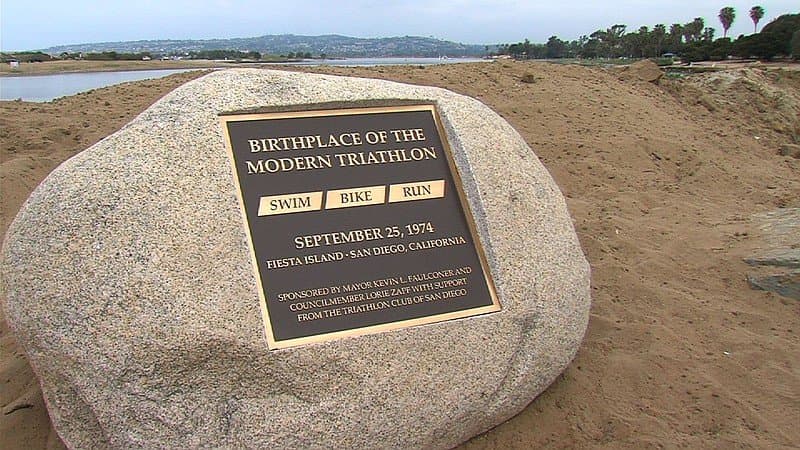
They got to work. Johnstone hand-drew a simple promotional poster, sketching the course and basic rules on a piece of paper. Shanahan handled the grassroots organizing within the club, persuading friends to try this new “game.” They chose a route right at Mission Bay: a 500-yard (about 450 m) swim in the bay, a 5-mile (8 km) bike ride around Fiesta Island, and a 6-mile (nearly 10 km) run on soft dirt paths along the shore. The entry fee was set at a symbolic one dollar, just enough to buy a few ribbons as prizes for the finishers.
Chapter 3: A “Live” Account of the Historic Race
On September 25, 1974, 46 people—including Johnstone, Shanahan, and Johnstone’s 13-year-old daughter—gathered at the starting line. The atmosphere was far from tense or competitive. It felt more like a sporty picnic. People joked about their outfits and teased one another. There were no aerodynamic, tight-fitting trisuits. Instead, there were waterlogged cotton shorts, worn-out Converse tennis shoes, and a fearless spirit. The bikes were just as varied—from sleek road racers to clunky Schwinns usually used for grocery runs.
The race began. Bill Phillips, a lifeguard and accomplished swimmer, quickly took the lead in the swim and emerged from the water to the applause of friends. The first transition (T1) was a scene of joyful chaos. Everyone scrambled to find their bikes—leaning against fences or cars—pulled shoes onto sand-covered feet, and headed out onto the bike course.
The run was the final challenge and where many experienced, for the first time, the strange yet signature sensation of triathlon: legs that felt like lead, as if they no longer belonged to the body after cycling. But no one stopped. They encouraged one another, shuffling toward the finish amid laughter and playful complaints. John Collins, who would later create the Ironman Hawaii, was also present in that race.
In the end, Bill Phillips won with a total time of 55 minutes and 44 seconds. But the true winners that day were all 46 participants. Together, they had completed something no one had done before. The results were handwritten by Johnstone and posted on the club’s notice board. A new chapter in sports history had been quietly written.
Chapter 4: Post-Race Reactions & Early Spread
The 1974 Mission Bay Triathlon did not attract media attention. But the spark it ignited spread organically within the athletic community. Participants became the first “ambassadors,” recounting the unique experience to friends with unmistakable excitement. They described a race that tested not just strength, but adaptability and willpower.
The following year, 1975, the race was held again with more participants. From there, early participants who moved to other cities carried the idea with them and organized similar events. Triathlon spread not through marketing campaigns, but through word of mouth—the most authentic and powerful form of growth.
An Invisible Legacy & Practical Lessons
The Soul of Triathlon: The Art of Transition
If one core legacy of Mission Bay 1974 must be chosen, it is the birth of the concept of Transition. Before that, sports existed in separate silos. Triathlon forced athletes to master change. Moving from a horizontal position in the water to sitting on a bike (T1), and from the circular motion of pedaling to the impact-driven motion of running (T2), demands remarkable physiological and psychological adaptation.
Life is the same. Success comes not only from being good at one thing, but from how well we adapt and transition between different phases of life. The spirit of T1 and T2 is the spirit of flexibility, resilience, and relentless forward motion.
The Spirit of Finishing, Not Winning
Another equally important legacy is that all 46 participants finished. From the very first race, an unwritten culture was established: in triathlon, finishing the race—defeating oneself—is often celebrated more than standing on the podium. This is a sport where the last finisher frequently receives the loudest and warmest applause.
Conclusion: Every Giant Was Once a Beginner
At Gopeaks, when we tell the story of Mission Bay 1974, we are not just recounting a historical event. We are reminding ourselves and our athletes of a simple yet powerful truth:
“You don’t have to start big to achieve greatness.”
Every great journey begins with a small, sometimes naïve step. The legendary Ironman Hawaii, the prestigious Olympics—all trace their roots back to that sunny afternoon, to a casual run that cost just one dollar.
Perhaps your own triathlon journey begins the same way today. With a weekend run to relieve stress. With a first bike ride after years away. With a quiet determination to change yourself. Remember the image of those 46 people at Mission Bay. Every “giant” you admire today was once a beginner just like them.
And Gopeaks is here to walk beside you on that very first step of your great journey.