
The History of Triathlon – Part I: An Epic of the Sport of Willpower
Triathlon Is Not a Sport.
It is a symphony of willpower.
A journey where humans willingly place themselves in adversity—not to defeat others, but to discover the greatest version of themselves. It is the answer to a quiet question deep inside each of us: “Where is my limit?”
And this is the story of the journey to find that answer.
Act I: The Call of the Wild (1970s–1980s) – The Age of Legends
Every epic begins with an idea that borders on madness. The history of triathlon is no exception. It was not born in an Olympic committee meeting room, but ignited by pure passion—and a touch of rebellion.
Chapter 1: The Big Bang at Mission Bay (1974)
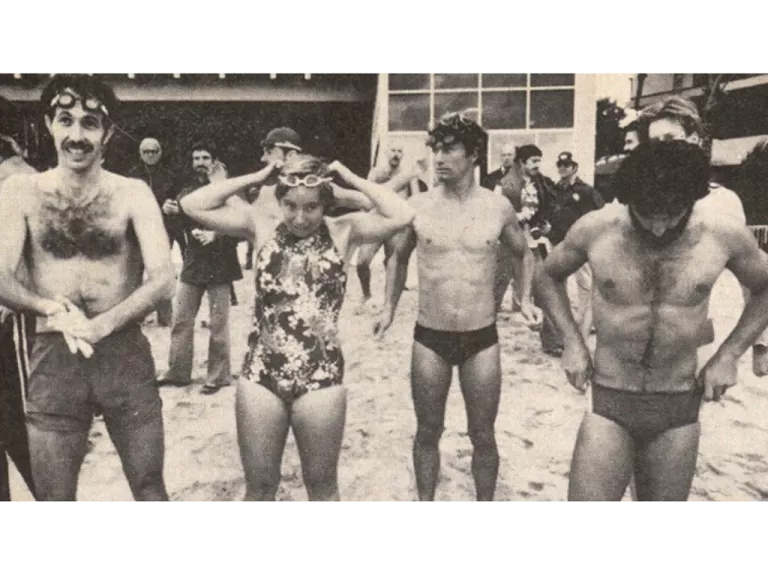
As explored earlier, it all began on a sunny afternoon in San Diego. Jack Johnstone and Don Shanahan, two members of a local track club, felt that their weekend runs had become too familiar. They craved a new challenge, a different kind of “fun.” And so, triathlon was born from a simple idea: combine the three sports they loved.
With 46 friends, a one-dollar entry fee, and improvised race outfits, they unknowingly triggered a Big Bang—creating an entirely new universe. They had no idea they were laying the foundation for one of the fastest-growing sports on the planet.
Chapter 2: The Birth of the “Ironman” From a Barroom Debate (1978)
If Mission Bay was the first spark, Ironman Hawaii was the wildfire that spread triathlon across the world.
The story began in 1977 at an awards banquet in Hawaii. Over a few beers, a debate erupted: Who is the toughest athlete—a swimmer, a cyclist, or a marathon runner?
Naval officer John Collins, who was present, stood up and proposed a bold solution:
“To settle this debate, let’s combine the three toughest races on this island into one single event.”
Those races were:
Waikiki Roughwater Swim (3.86 km)
Around-Oahu Bike Race (185 km)
Honolulu Marathon (42.2 km)
He declared: “Whoever finishes first, we’ll call them an Iron Man.”
In February 1978, fifteen men dared to accept the challenge. Only twelve finished. Gordon Haller, a Navy communications specialist, became the first Ironman in history with a time of 11 hours and 46 minutes.
A legend was born—from a beer-fueled argument.
Chapter 3: The Immortal Moment of Julie Moss (1982)
In its early years, Ironman was still relatively unknown. That changed in 1982, when the world witnessed one of the most emotional and defining moments in sports history.
Julie Moss, a young college student, was leading the women’s race convincingly. But just meters from the finish line, her body betrayed her. Severely dehydrated and exhausted, she collapsed onto the asphalt. ABC Sports cameras captured everything.
Instead of quitting, Julie Moss crawled. With every last ounce of willpower, she dragged herself toward the finish line. At that moment, Kathleen McCartney passed her to win the race. But the image of Julie Moss crawling to finish second was broadcast across America.
That moment defined the soul of Ironman.
It was not about the winner—it was about unbreakable will.
Millions watched and asked themselves: “If she can do that, why can’t I at least try?”
Registrations for the following year skyrocketed. In defeat, Julie Moss became one of the greatest inspirations of an entire generation.
The 1980s also saw the rise of iconic races such as Escape From Alcatraz, Nice Triathlon, and Wildflower—each with its own identity—creating a golden, wild, and romantic era for triathlon.
Act II: Into the Open Sea (1990s–2000s) – The Era of Recognition
If the 1980s were the age of rebels and heroes, the 1990s and 2000s marked triathlon’s coming of age—stepping onto the global stage with a new identity.
Chapter 1: The Road to the Olympics
To be recognized as a legitimate sport, triathlon needed a global governing body and standardized competitions. In 1989, the International Triathlon Union (ITU—now World Triathlon) was founded. The first World Championship was held in Avignon, France, introducing a new standardized distance:
1.5 km swim
40 km bike
10 km run
This became known as the Olympic distance.
After more than a decade of relentless lobbying, the ultimate dream came true. In 2000, at the Sydney Olympic Games, triathlon made its Olympic debut. Images of athletes swimming in front of the Sydney Opera House became iconic—cementing triathlon’s place on the world’s biggest sporting stage.
Chapter 2: Expanding the Borders
This era was not only about elite recognition, but also about inclusivity and diversity.
Danskin Series (1990):
Created exclusively for women, this series offered a friendly, safe, and supportive environment. It successfully introduced hundreds of thousands of women to triathlon, proving the sport was not just for men.XTERRA (1996):
Tired of paved roads, a group of athletes in Maui took triathlon into the wild—ocean swimming, mountain biking, and trail running. XTERRA was born, opening a new frontier for nature lovers and adventure seekers.Ironman 70.3 (2005):
One of the smartest strategic decisions in triathlon history. Recognizing that the full Ironman (140.6 miles) was too daunting for many, Ironman introduced the “half Ironman.” Long enough to be epic, yet short enough for people with jobs and families to train for, Ironman 70.3 sparked a global boom—bringing the Ironman dream closer to millions.
Act III: The Modern Revolution (2010s–Present) – The Era of Speed & Professionalism
In the 21st century, triathlon continues to evolve—faster, more professional, and constantly pushing boundaries.
Chapter 1: Millions, Media, and New Powers
Million-dollar prize races like Hy-Vee elevated professional athletes. New, fast-paced, TV-friendly formats such as Super League and the PTO (Professional Triathletes Organisation) emerged, challenging Ironman’s dominance. Events like the Collins Cup and the T100 series created elite battlegrounds, turning athletes into global stars.
Chapter 2: Nothing Is Impossible
The spirit of conquering limits remains triathlon’s core.
Paratriathlon at the Paralympics (2016):
For the first time, athletes with disabilities competed at the Paralympic Games, writing stories of resilience greater than any record.Project Sub7/Sub8 (2022):
Triathlon’s answer to Nike’s Breaking2. With full scientific support, elite athletes proved that the full Ironman distance could be completed under 7 hours for men and 8 hours for women—shattering a once-unthinkable psychological barrier.
Even sacred traditions evolved. For the first time in history, the Ironman World Championship moved away from Kona (2021), later adopting a rotation between Kona and Nice, with separate race days for men and women. It was proof that even a nearly 50-year-old sport must adapt to grow.
Conclusion: A Sky Full of Stars—and Our Journey
Each race is a star.
The entire sky is a dream.
From a spontaneous idea between two men, triathlon has become a global ecosystem—a family of hearts that refuse to quit.
And from Vietnam, we at GoPeaks are looking up at that star-filled sky.
We know we are just a small dot.
We know we came later.
But when we look back at triathlon’s nearly 50-year journey, we understand that history is written by those who dare to begin, dare to dream, and dare to challenge the impossible.
The history of triathlon is still being written.
And we believe that, with an unyielding spirit, one day a star named “Vietnam” will shine brightly in that sky.