

Ironman 70.3 Phu Quoc 2025: 9 Survival Tips for First-Timers
With just over two weeks left until the big day: the IRONMAN 70.3 Phu Quoc on November 16, 2025, all the hard work and training over the past months is converging on one point. This is the most crucial Taper (Reduction) and mental preparation phase.
As a Level 2 certified coach from USA Triathlon , I want to share 9 "survival" tips, specially tailored for those attempting the 70.3m race in Phu Quoc for the first time. These aren't just theories; they're practical strategies for the next 14 days.
Let's get started!
1. Managing Taper Craniness & Family Planning
If you've been training for the past six months, your family has also been "training" with you. They've patiently endured your early mornings and long weekend bike rides. Now it's time to thank them.
But also warn them: The "taper" phase can turn athletes into taper crankiness because we're used to high intensity and now we need to rest. Talk to your family, confirm your travel plans and race day schedule so they know exactly when to cheer you on at the Three Coconut Trees Beach area or at the Ironman finish line.
After the race, treat yourself and your family to a trip to Phu Quoc. Remember that the lesson [Cultural Adaptation Strategies] is an integral part of triathlon.
2. Analysis of the Ironman 70.3 Phu Quoc Race: Hot and Humid
You're no longer choosing a race; you're preparing to fight the race you've chosen. And the Ironman 70.3 Phu Quoc experience has its own unique characteristics: HOT and HUMID.
Swimming (1.9km): Take a swim around Three Coconut Trees Beach. The sea water in Phu Quoc is very warm (usually above 26-28°C), meaning wetsuits are unlikely to be allowed . The salinity helps with buoyancy, but be careful not to swallow seawater.
Cycling (90km): Two loops are relatively flat and fast. But "flat" doesn't mean "easy." You'll be completely exposed to the sun and sea breeze. Don't get carried away by the speed on loop 1; you'll pay the price on loop 2.
Running (21.1km): This is where the real race begins. You'll run two laps in peak hot and humid weather. The course is beautiful along the coast, but there will be very little shade. The heat will be your biggest challenge.
3. Finalize the Race Day Plan
This phase is no longer about building physical fitness, but about perfecting your strategy. Your plan must answer these questions:
Pacing: What resistance level (RPE) will you be at while swimming? What power or heart rate zone will you be maintaining while cycling? What is your target running pace, and do you plan to walk to water stations (aid stations)?
Nutrition: What exactly will you eat and drink every 15-20 minutes? How many grams of carbs per hour? Will you be using the gel provided by the organizers or bringing your own?
4. Pacing Strategy: Respect the Heat!
Here's the most important tip for your first Ironman 70.3 in Phu Quoc: Slow is fast . Most first-timers fail because they get too excited and burn out too quickly.
In Phu Quoc, the heat will cause your heart rate to rise higher than normal.
Cycling: Start the cycling portion at a 10% slower pace than planned.
Running: Start by running 15-20 seconds slower per kilometer than your training pace.
Your body needs time to adapt. It's better to run faster in the last 5km than to walk the last 10km.
5. Have complete faith in the Taper Phase.
Over the next two weeks, your body will be screaming for more exercise. You'll feel sluggish and slow. THAT'S NORMAL. It's a sign your body is absorbing all the benefits of your workout.
You can't "cram" your fitness in 14 days. Any heavy training now will only make you more tired on race day. Stick to your coach's taper plan: reduce volume but maintain some intensity with short intervals to keep your system sharp.
6. Nutrition & Hydration: A Vital Factor for Survival
In Phu Quoc, nutrition isn't the key to success; it's the key to survival . Due to the high humidity, sweat doesn't evaporate quickly, making it very difficult for the body to cool itself down.
Hydration: Drink according to a schedule, DO NOT wait until you are thirsty.
Electrolytes: This is a crucial factor. You need to replenish salt (sodium) continuously. Use salt tablets or sports drinks with high electrolyte content. Plain water alone is not enough and can be dangerous (hyponatremia).
Practice: Make sure you're training with the exact same gels and electrolytes you'll be using on race day for the next two weeks.
7. Prepare yourself mentally for the "battle" in the second lap.
There will be times, especially on the second lap, when the heat reaches its peak, when you'll want to give up. You'll wonder why you're torturing yourself like this.
Prepare yourself for that moment. Accept that it will happen. When it comes, break the race down:
"Just run to the next water station."
"Just go past that coconut tree."
Use positive mantras. Think about why you started. And visualize the moment you cross the finish line in Sunset Town.
8. The Golden Rule: "Nothing new on race day!"
The golden rule: "Nothing new on race day."
For these two weeks, don't try any new shoes, a new trisuit, new gels, or new types of goggles (use the new goggles you normally use). You must use 100% of the equipment you are already familiar with during training.
Have your bike checked this week. Don't wait until the day before the race to get it serviced. Make sure your tires, brakes, and drivetrain are all in perfect working order.
9. Plan your check-in when you arrive in Phu Quoc.
As soon as you arrive in Phu Quoc (usually the Thursday or Friday before the race), take some time to survey the site:
Transition Zone (T1, T2): Where are they? Where are the entrances and exits? Where should I place my belongings, landmarks, etc.?
Try swimming: Go to the beach and swim a short distance. Feel the saltiness of the water and look at the sights on the shore.
Race track: If possible, cycle or drive a short distance on the track to get a feel for the road surface and wind direction.
This helps reduce stress and eliminate surprises on race day.
Are you ready for the Finish Line?
Your journey is nearing its end. The next two weeks are for rest, logistical preparation, and keeping your mind sharp. Trust your training. You've worked hard. Now, go out there and enjoy your day.
Coach looks forward to seeing you all at the finish line of Ironman 70.3 Phu Quoc!
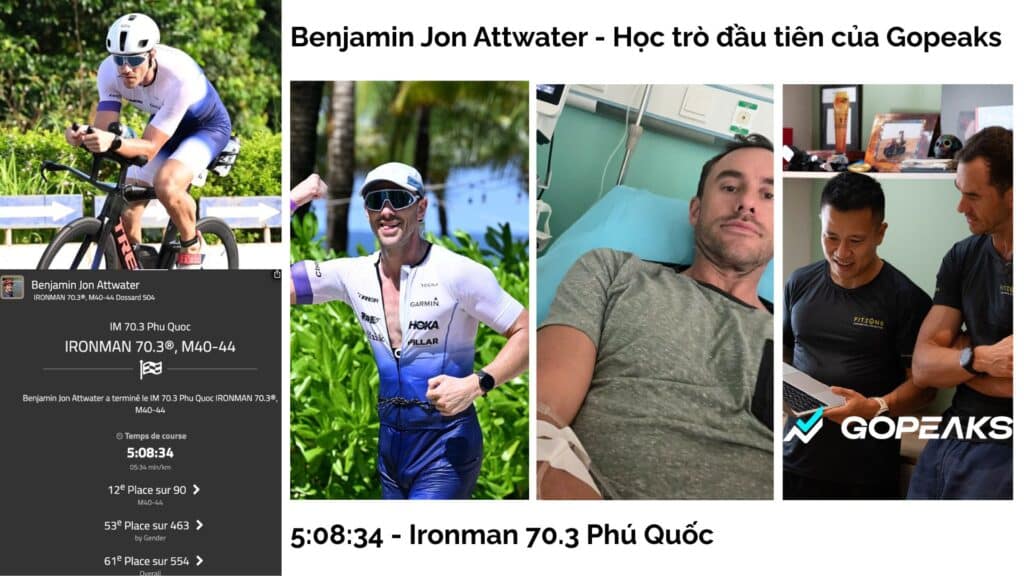
Benjamin Jon Attwater– Gopeaks' first student
PS: An inspiring story from Gopeaks
I want to tell you about Ben Jon Attwater. Ben was Gopeaks' first student, even two months before the name Gopeaks was created. After a performance analysis session, Ben decided to take me on as his coach immediately, even though I was still studying coaching at the time and had no intention of taking on students.
Just because Ben asked, "Why haven't we had any training yet?" the following week, I officially became his coach from that day on. (Ben also stopped training with a coach abroad despite having trained for 6 months).
But the dramatic part is this: Ben, a renowned chain restaurant chef in Saigon, suffered severe food poisoning and had to be hospitalized just two weeks before the race. With only four days left before the competition, Ben was still in the hospital.
However, with everything he had learned and practiced, Ben gave his all at last year's Phu Quoc Ironman 70.3 and finished with a time of 5:08:34 . A remarkable achievement for someone new to triathlons under such circumstances!
Ben's story is the clearest proof: The upcoming exam is just a gentle test of what you've learned over the past time. The race isn't too difficult. Trust in the process and enjoy your day!