
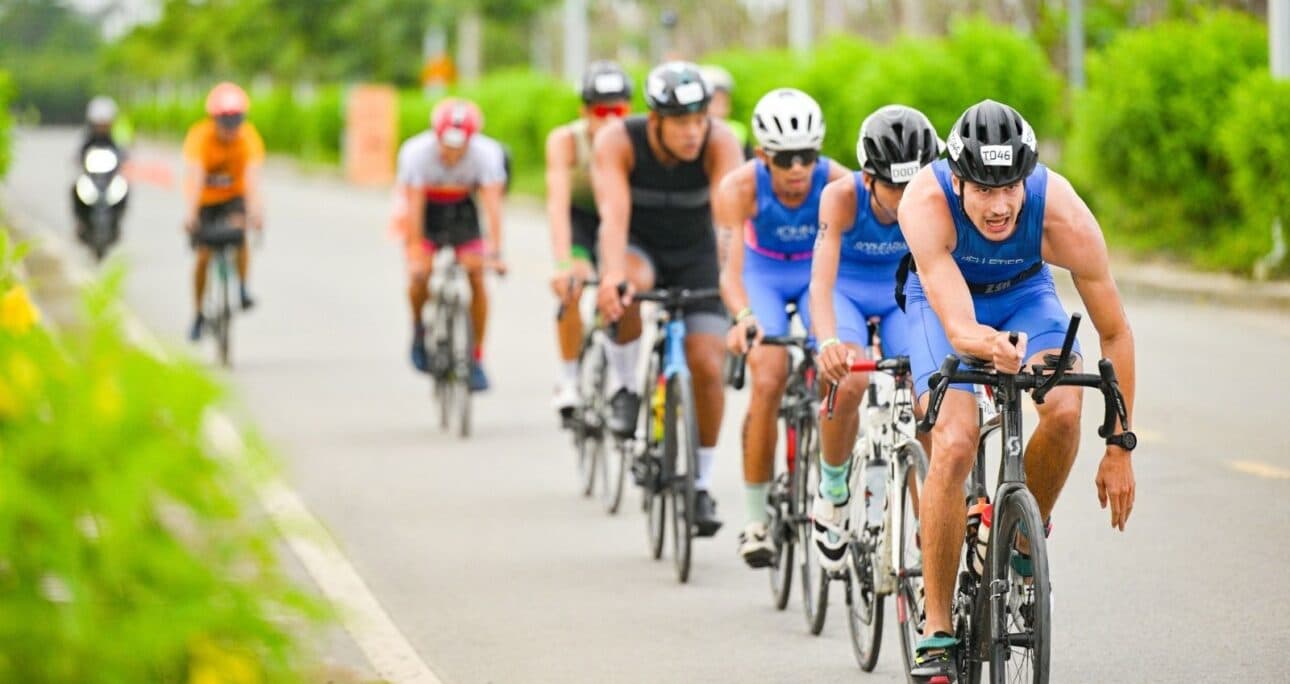
Reading the wind and arranging the fan: Conquering the wind in a long-distance race.
Reading the wind and positioning your fan is a crucial skill in long-distance racing. Accurate wind reading and proper fan positioning allow you to move faster with less energy, easily catch the breakaway group, and finish strongly. This article presents the information in a coherent, easy-to-understand manner, yet with enough depth to apply immediately to training and race day.
1) Reading the wind and arranging the fan: Start by "seeing" the wind.
Wind has three main forms of impact:
Headwinds slow the entire group down; a long line, slow and smooth towing changes are optimal.
A favorable wind helps increase speed; the position before entering a corner or at the finish line is crucial.
Diagonal winds are the "peloton splitters"; this is where fan placement comes into its best effect.
A simple way to read the wind before and during a race: observe the flags, smoke, tree canopy , listen to the wind through your hat, feel the wind on your shoulder, and look at the shadows (a shadow slanted to the left → wind from the left; a shadow slanted to the right → wind from the right). From there, you decide which side of the road ahead of the competitor should stand in the downwind lane.
2) How to position the echelon fan: should it be positioned on the sheltered side?
Imagine the person in front of you as a "windbreak." You're not standing directly behind them, but rather leeward, receiving the disrupted airflow.
Wind from left to right : the windbreak will shift to the right ; the person pulling will be blown to the left (downwind side) to drift backward.
Wind coming from the right : do the opposite.
Maintain a safe distance: look 2–3 wheels ahead, shoulders relaxed, hands ready on the brake; only half-overhang the wheels to avoid "cutting off" the wheel when the person in front changes direction. On narrow roads, fan only as wide as the lane—don't encroach on other lanes; if there isn't enough space, split into two smaller fans .
3) Rotates smoothly like a clock.
An efficient fan needs a consistent through-and-off rotation:
In the inner row (the side that's sheltered from the wind), you move up to the front seat.
When you've just passed the lead driver's wheel, go straight for 3–5 seconds —don't turn the steering wheel yet.
Move towards the upwind side so that the person behind you can get into your sheltered spot.
Gently release your foot to let the bike roll to the end of the line, breathe deeply, adjust your rhythm, and prepare for the next lap.
Everything went smoothly, no jerking , no sudden braking, and I didn't have to bend down to change the water bottle while the load was rotating.
4) Tactics in a peloton when crosswinds arise
When the lane is open and the wind is lashing across, the stronger team will "block the lane" : occupying the entire width of the lane on the leeward side, leaving those behind with nowhere to take cover. The Peloton will immediately break into pieces.
Therefore, maintain a position at the front third of the pack. If you are unfortunately pushed backward, don't chase straight into the wind; cut diagonally into the windward side to catch the fan's tail, and then rejoin the pack. Experience shows that effective bridges are usually short, decisive 30-60 second efforts at the right angle, rather than prolonged drag-out maneuvers in bad winds.
Within the team, everyone's role must be clearly defined: the rouleur maintains the pace; the climber protects on the slopes; the sprinter/leader minimizes wind exposure and is brought up at the crucial moment during the decisive section.
5) Pacing and energy: Race smart, don't just "grind" recklessly.
In the fan, power isn't flat. When you 're pulling ahead , increase just enough to maintain speed (usually around your race threshold); when drifting behind , let go for a moment to allow your body to catch its oxygen. If the group decides to lock down , replenish carbohydrates regularly—many riders run out of steam not because their legs are weak, but because… they forgot to eat.
6) Equipment & setup for a windy day
Wheels: In strong winds, prioritize shallower front wheel placement for better steering stability; rear wheels can be deeper.
Tire pressure: On rough roads or in the rain, slightly lower the recommended pressure by a few psi to increase traction.
Position: into drops when speed is high/wind is strong; when more control is needed, grip the hoods .
Clothing & gear: close-fitting, streamlined top; water bottle in the center triangle; everything designed to minimize wind exposure.
7) How do I practice to become proficient?
You can practice on your own, but it's best to practice in a small group in a safe, disciplined environment with an experienced instructor.
The "Basic Fan" exercise : walk in a large circle in the direction of the wind, practicing in both directions; each person does this for 8–12 seconds, with a steady rotation rhythm.
The "Blocking the Way" exercise : choose a windless section, the whole group moves to the sheltered side, and maintain a consistently high speed for several minutes to feel the characteristic "pain" of crosswind.
The "Bridge" technique : from behind, a short, decisive acceleration diagonally downwind to follow the fan—at the right angle, at the right time.
At the end of the session, we analyzed the situation together : who took the corner too wide, who turned too early, who forgot to use hand signals. Improvement comes from these small adjustments.
8) Common mistakes (and how to fix them quickly)
Standing on the wrong side : the golden rule— always stay on the downwind side . Every time the wind changes, the fan switches sides.
Steering when towing : go straight, cut behind; avoid sharp turns that could cause the driver behind to brake hard.
Chaotic rotation rhythm : standardize commands/finger gestures; if someone pulls too hard, shorten the pulling time instead of pulling… harder.
Forgetting to eat or drink : set reminders on your watch every 15–20 minutes; choose gel/sticks that are easy to open with one hand.
9) Checklist before the crosswind
Tightening bolts – brakes – starter – battery, tire pressure; map of sections with frequent crosswinds (after curves, open roads, coastal/field areas); hand signal conventions within the group; gels, water, electrolytes; a light windbreaker if needed.
Conclude
Reading the wind and positioning your gears isn't some kind of magic formula—it's about disciplined observation , proper positioning , smooth rotation , and timing your energy correctly . When you master these four things, the wind from your enemy becomes your ally. At Gopeaks, we consider this a core skill in our road simulations: learning to race smart, safe, and efficient —so every gust of wind is a breakaway opportunity.