
The Invisible Debt: The Art of Mastering the Cycling-Riding Relationship
You've probably been there before. It feels hauntingly familiar.
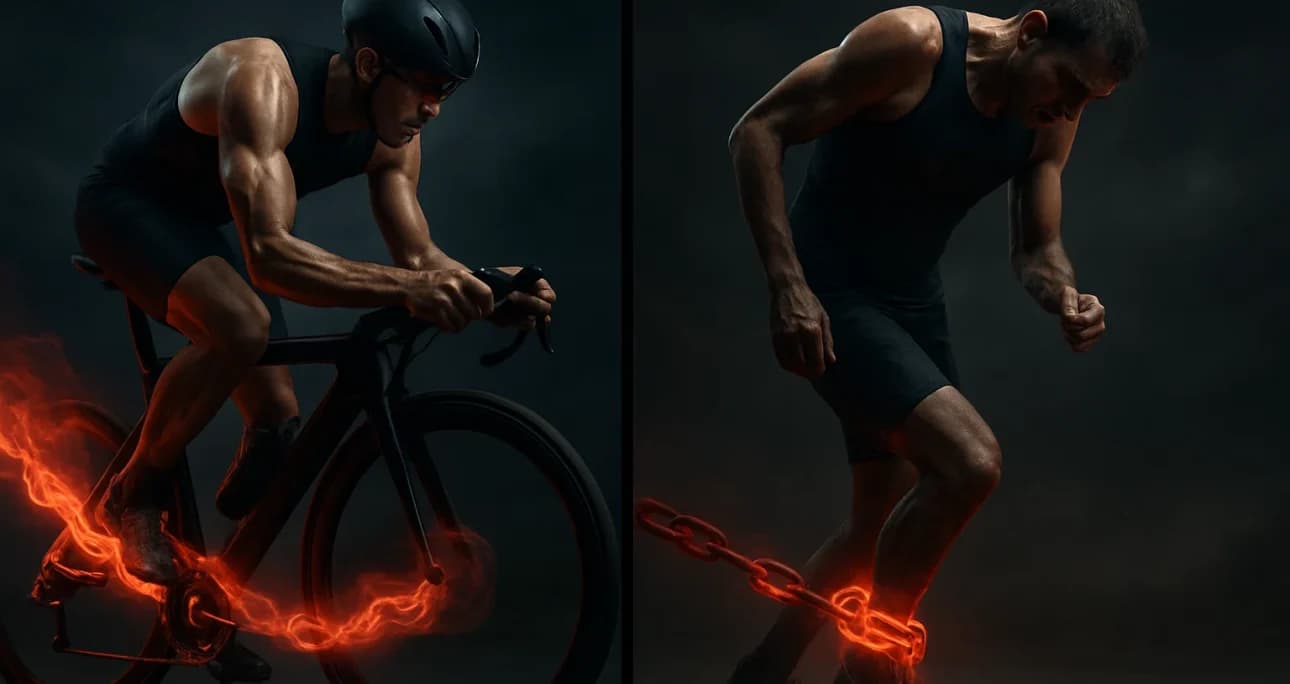
You've just finished the cycling portion with an impressive time, your legs still feeling powerful. You confidently head into T2 (the transition zone), your mind ready for a good run. But then, after just the first few kilometers, a harsh reality strikes. Your legs feel like they're weighed down with lead. Your energy suddenly vanishes. Every step is a struggle. The speed you expected vanishes into thin air.
You have become a victim of an “invisible debt”—a debt that the cycling part “borrowed” and the running part must “repay” at all costs.
At GoPeaks, we call this the decisive moment of a triathlon race. Success or failure doesn't lie in how fast you pedal or run in individual training sessions. It lies in mastering the inseparable relationship between pedaling and running .
The FTP Trap: Why "Stronger" Doesn't Mean "Faster"?
For years, the cycling and triathlon community has revered the Functional Threshold Power (FTP) as king. The higher the FTP, the stronger the rider. That's true, but it's not enough, especially in a long race.
FTP is like a snapshot of your strength over 60 minutes. But an Ironman 70.3 or 140.6 race is a 5, 10, or even 15-hour movie. That snapshot can't tell the whole story. It doesn't tell us:
How will you maintain that strength during the 3rd and 4th hour of the cycling phase?
How will your performance decline when your body has accumulated a significant amount of fatigue?
And most importantly: What do you have left for the running portion?
That's why at Gopeaks, we don't just look at FTP. We build a comprehensive power profile , a 3D picture of your strength, where endurance and durability are paramount.
“Wiggle Room” – A Strategic Silence for Explosive Performance
Imagine a clever trade-off. The concept of "wiggle room" is the art of that trade-off.
Option A: You pedal intensely, trying to shorten your cycling time by 5 minutes. Result: You enter the running portion with exhausted legs and finish 15 minutes slower than your potential. Total time: 10 minutes slower.
Option B: You intentionally slow down a bit, conserving energy, accepting a 2-minute delay to T2. Result: You have a powerful, well-balanced run, and finish 12 minutes faster than scenario A. Total time: 10 minutes faster.
This is the essence of triathlon. The winner isn't the strongest in each discipline, but the one who intelligently transfers energy between them. At Gopeaks, we help you find your own optimal "flexibility range."
Fatigue Resistance – The Superpower of Long-Distance Champions
So, what's the secret behind option B? It's Fatigue Resistance.
This is not an abstract concept. It is a measurable and trainable physiological capacity. It is the ability to maintain performance (pedaling power or running speed) after hours of competition without significant decline.
An athlete with high fatigue resistance is like a high-performance hybrid car:
They know how to effectively utilize the body's sustained "diesel" energy source (fat).
They only use their reserve of "premium fuel" (glycogen) at critical moments.
Their neuromuscular systems are trained to withstand prolonged stress without "shutting down."
Building a "Fortress" Against Fatigue: The Gopeaks Training Roadmap
Fatigue resistance isn't something that comes naturally. It has to be built intentionally, brick upon brick. This is our design:
Training strategy | Objective – Why do we do this? |
Increase your bike volume. | To expand energy reserves and teach the body to use fat more efficiently. |
Cycling consecutively for several days (Back-to-back) | To simulate the feeling of competing on the second day with tired legs, and to train willpower and endurance. |
Race Simulation | To allow your body and mind to acclimatize to the actual stress levels of exam day, adjust everything from nutrition to pacing. |
Two workouts per day (Doubles) | To activate deeper metabolic adaptation mechanisms and accelerate recovery. |
Combine smart weight training. | To build a strong chassis, enhance the strength of the underlying muscles and the durability of the neuromuscular system. |
Periodic Fatigue Resistance Test | To track progress, see how tall and strong your "fortress" has become. |
"X-raying" Endurance: How We Measure the Invisible
How do we know you're making progress? We don't guess. We measure.
Using state-of-the-art analytical tools like WKO5, we can "X-ray" your fatigue resistance. We consider:
The decrease in your power output after expending a large amount of energy (e.g., 1500 kJ).
Compare your strength at the beginning and end of a long workout session.
Fatigue Resistance Curve Analysis.
But data is only part of the story. We also observe more subtle cues: heart rate drift , cadence , and most importantly, listening to your own subjective feelings (RPE) .
Core Philosophy: Don't Try to Be "Better Tired"
At GoPeaks, we don't train you to be the best at enduring fatigue. We train you to be the smartest competitor.
Peak performance doesn't come from pushing numbers to the absolute limit in individual training sessions. It comes from the ability to maintain consistent and strong performance even when the body is fatigued. It comes from running 10 minutes faster simply by daring to slow down by 2 minutes.
It's the art of mastering invisible debt. And it's the path to truly conquering your own limits.