
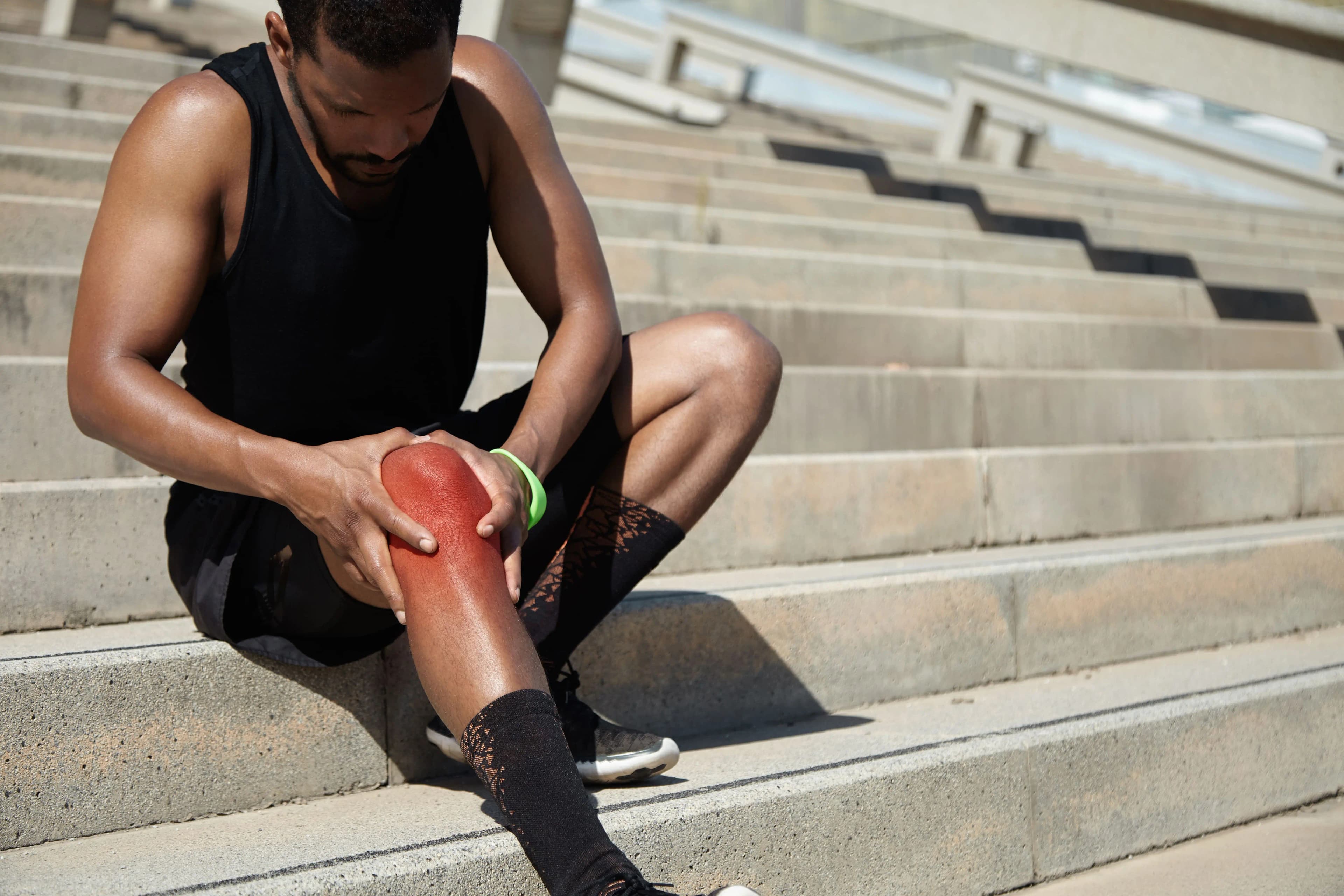
Sports Injuries – Understanding Them Correctly, Preventing Them Effectively
When engaging in long-term sports training – especially endurance sports like running, cycling, swimming, or triathlon – the risk of sports injury is always present.
The difference between someone who can maintain consistent performance and someone who has to give up due to injury lies not in luck, but in the knowledge of recognizing, classifying, preventing, and managing training load .
In sports medicine, sports injuries are generally divided into two main groups:
Overuse injuries – these accumulate gradually over time.
Acute injuries – occur suddenly due to a strong external impact.
1. What is a Sports Injury?
Sports injuries are any damage that occurs to muscles, tendons, ligaments, bones, or joints during training or competition.
1.1. Common Misunderstandings
Thinking that only falls or severe impacts can be considered injuries.
They believe that injuries are a matter of "bad luck" and cannot be prevented.
Ignore minor aches and pains and treat them as normal.
In fact, most injuries originate from repeated micro-injuries or biomechanical imbalances before any apparent symptoms appear.
2. Sports Injuries Due to Overuse – Overuse Injuries
2.1. Biological Mechanism
The body has the ability to adapt to mechanical load through tissue remodeling processes (tendon remodeling, muscle hypertrophy, bone remodeling). However, when the load exceeds the recovery capacity, this process becomes cumulative damage.
Formation process:
Repetitive load: muscles, tendons, and bones are subjected to repeated stress (e.g., thousands of running steps).
Micro-injuries: small tears in collagen fibers and muscle tissue.
Insufficient recovery: not enough time for regeneration → old damage + new damage.
Chronic inflammation – structural weakening: reduced load-bearing capacity → prone to cracking/fracturing.
Practical example: A runner who increases their distance from 20km/week to 40km/week in one week is more likely to experience shin splints or stress fractures.
2.2. Common types of overload
Achilles Tendinopathy – Inflammation of the Achilles tendon.
Plantar fasciitis – Inflammation of the plantar fascia.
Shin Splints (MTSS) – Pain along the tibia.
Patellofemoral Pain Syndrome (Runner's Knee) – Pain in the front of the knee.
Stress Fracture – A fracture caused by repetitive load.
2.3. Risk Factors
Increasing workload too quickly: not adhering to the 10%/week rule.
Incorrect technique: overstride, bending the knee too much.
Muscle imbalance: weak glutes → knees pull inward while running.
Inappropriate footwear/equipment: worn soles, lack of support.
Nutritional deficiencies and lack of sleep reduce the ability to repair tissue.
2.4. Early Warning Signs
The pain is dull at the beginning of exercise, lessens during warm-up, but returns more intensely after the workout.
Stiff joints in the morning or after sitting for a long time.
The pain is diffuse and not localized to a specific point.
3. Acute Sports Injuries
3.1. Biological Mechanism
This occurs when the instantaneous force exceeds the elastic limit of the tissue, resulting in tearing, fracture, or dislocation.
Reason:
Direct impacts: collisions, falls, soccer balls colliding.
Indirect effects: twisting, spraining joints, excessive jumping.
3.2. Common Situations
Ankle sprain.
Anterior cruciate ligament (ACL) tear.
Shoulder dislocation.
Fractured clavicle.
3.3. Risk Factors
A contact sport.
Does not boot up or boots up only partially.
Joint instability due to weakness of the supporting muscles.
Lack of focus during the competition.
4. The Intersection Between Overuse and Acute
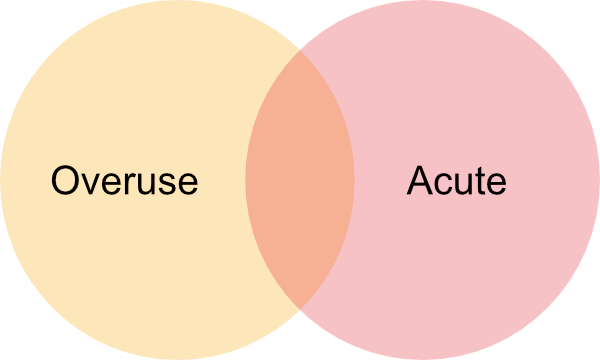
The chart shows that some sports injuries can be both overuse-related and acute. Source: sportsmedinfo.sg
In many cases, these two types of injuries are not completely separate:
Achilles tendonitis (overuse) → reduced weight-bearing capacity → increased risk of tendon rupture during jumping (acute).
Acute fracture → recovery but overtraining → stress fracture (overuse).
Lesson learned: Prevention requires a parallel approach of managing cumulative load and reducing collision risk.
5. Principles of Sports Injury Prevention
5.1. Proper load management
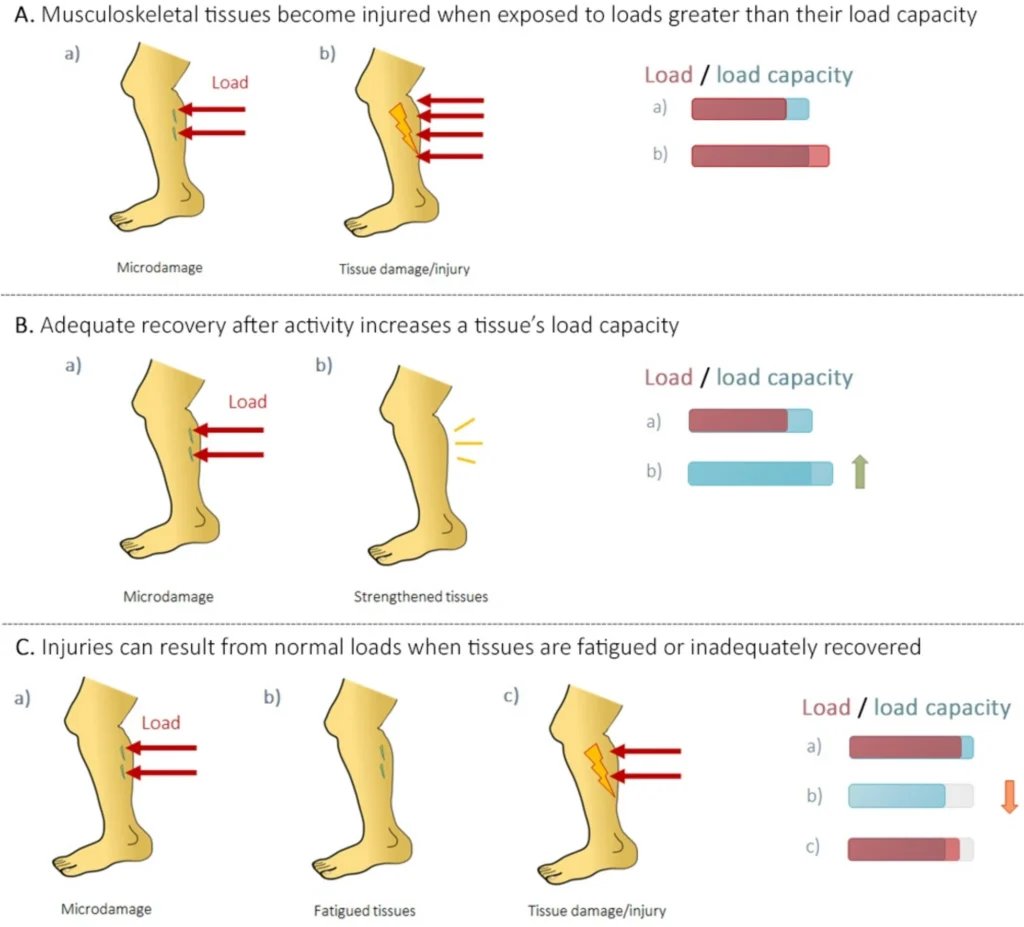
The way mechanical load is applied and the load-bearing capacity of tissue affect the risk of injury and recovery.
Source: Injepijournal.biomedcentral.com
Follow the 10%/week principle.
Alternate between intensive sessions, light sessions, and recovery sessions.
Organize a recovery week after 3–4 weeks of intense training.
5.2. Cross-Training
Add swimming, cycling, and yoga to reduce stress on the major muscle groups.
Helps improve cardiovascular function and overall body strength.
5.3. Application of rehabilitation therapies
Foam rolling, dynamic stretching after practice.
Supportive therapies: cryotherapy, sports massage, heat therapy, EMS, strength and conditioning training, etc.
5.4. Nutrition & Sleep
Protein: 1.6–2.2g/kg body weight/day for muscle regeneration.
Omega-3s and natural anti-inflammatory foods (salmon, berries).
Sleeping 7–9 hours per night optimizes hormone recovery.
5.5. Technology & Equipment
Thanks to the coach's regular technical checks.
Shoes should be suitable for running and replaced after 600–800 km.
Maintain your equipment (bicycle, racket, etc.) to avoid accidents.
6. When Injuries Occur
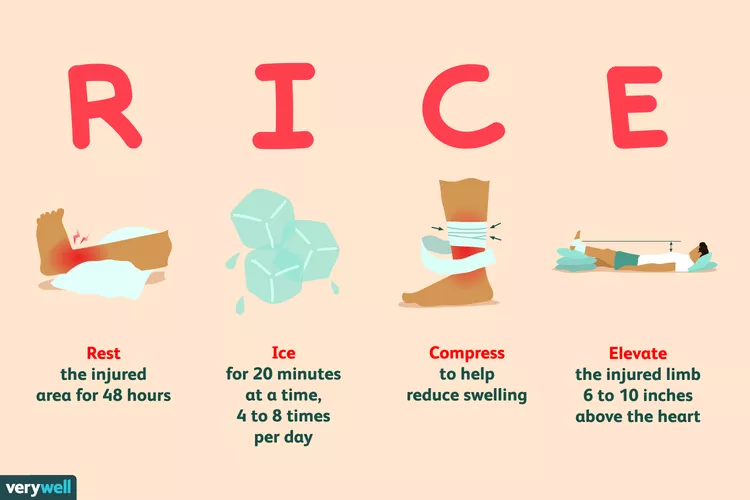
RICE: Rest – Ice – Compress – Elevate, basic first aid method for acute injuries. Source: verywellhealth.com
Overuse: Get adequate rest, adjust the load, and perform exercises that do not cause pain.
Acute: RICE (Rest – Ice – Compression – Elevation) may be considered within the first 48 hours, but it is best to see a doctor for examination.
Consult a sports physician or orthopedic surgeon if the pain lasts longer than 7 days or there is significant swelling.
7. Conclusion
Sports injuries are a common challenge for all athletes, from professional to amateur. Understanding the mechanisms, recognizing them early, and implementing scientific prevention methods will help you:
Reduce the risk of taking extended breaks from training.
Maintain high performance.
Reap the full health benefits of sports.
Remember: prevention not only protects your body today, but also lays the foundation for your performance 5–10 years from now.