
The Impact of Sleep Deprivation on the Recovery Process
Lack of sleep doesn't just make you feel tired and unfocused. In sports, the effects of sleep deprivation are far more far-reaching: from muscle recovery, strength, and reflexes to the risk of injury. Sleep is fundamental to physical regeneration and development, yet it's often overlooked in training plans.
This article will analyze the effects of sleep deprivation based on physiological and scientific evidence, and offer solutions to improve sleep quality, optimize performance, and minimize injury.
1. Why is sleep important for athletes ?
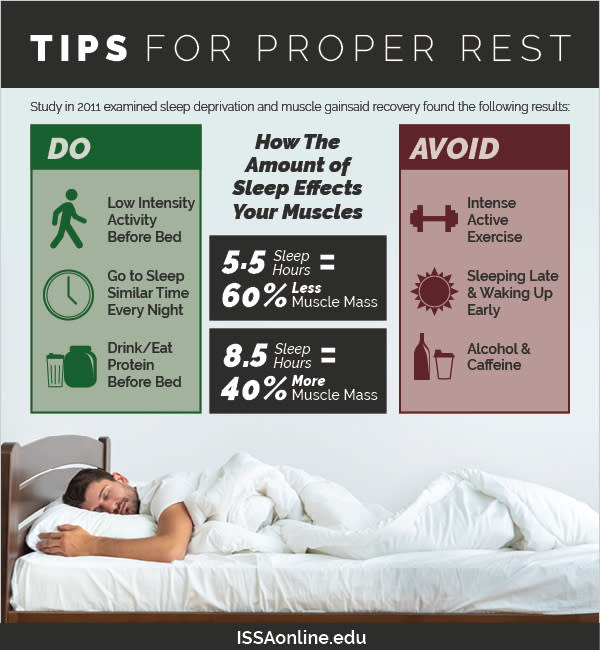
The image illustrates the impact of sleep on muscle recovery and growth. Source: Issaonline.com
Sleep is the stage during which the body enters a complete recovery process:
Tissue and muscle regeneration : During deep sleep (NREM), the body releases growth hormone (GH), which helps repair muscle fibers and synthesize proteins.
Hormone balance : Adequate sleep helps stabilize cortisol—the stress hormone—while maintaining testosterone, a key factor for strength and endurance.
Strengthening motor memory : REM sleep helps the brain remember techniques and strategies, and increases the ability to learn new skills.
When you're sleep-deprived, this entire process is disrupted, leading to a chain reaction of sleep deprivation effects on health and performance.
2. The impact of sleep deprivation on recovery ability
The first effect of sleep deprivation is a reduction in the speed and quality of recovery:
The amount of GH hormone secreted decreases sharply.
High cortisol levels inhibit protein synthesis and prolong inflammation.
Glycogen stores regenerate slowly, leaving you feeling sluggish during your next workout.
As a result, the body takes longer to recover, and is more prone to overload and overtraining.
3. The impact of sleep deprivation on strength and endurance
Lack of sleep weakens the ability to generate strength and withstand high-intensity exercise:
Reduced ability to mobilize motor units from the central nervous system.
Reduced efficiency in ATP resynthesis – the main energy source for muscles.
Reduce explosive power, especially in weightlifting, sprinting, and contact sports.
Studies show that just 2–3 nights of sleep deprivation can reduce peak performance by 10–15%.
4. The impact of sleep deprivation on reflexes and decision-making ability.
One dangerous effect of sleep deprivation is that it slows down information processing speed and reflexes:
Reduced activity in the prefrontal cortex leads to decreased concentration and problem-solving abilities.
Reduced accuracy in complex technical movements.
Slower reaction time in high-speed competitive situations.
In sports that require quick reflexes, a delay of 0.1 seconds can be the difference between success and failure.
5. The impact of sleep deprivation on injury risk
Lack of sleep doesn't directly cause injuries, but it does create conditions that make injuries more likely to occur:
Poor recovery leads to weaker muscles and reduced load-bearing capacity.
Slow reflexes → difficulty avoiding collisions.
Reduced joint and ligament stability.
One study showed that athletes who sleep less than eight hours a night have twice the risk of injury compared to those who get enough sleep.
6. How to recognize the effects of sleep deprivation
Signs that you are suffering from sleep deprivation :
Constant fatigue leads to decreased training performance.
Strength decreases during familiar exercises.
Prolonged muscle pain, difficult to recover from.
Poor reflexes and concentration.
Irritability and lack of motivation to exercise.
7. Solutions to reduce the impact of sleep deprivation
To reduce the effects of sleep deprivation , you should:
Maintain a consistent sleep schedule : keep your bedtime and wake-up time fixed each day.
Optimal sleeping environment : dark, quiet room, temperature 20–22°C.
Limit caffeine intake after 2 PM and avoid electronic devices for 30 minutes before bedtime.
A short nap is recommended : 20–30 minutes at midday to increase alertness.
8. Conclusion
The impact of sleep deprivation on sports performance cannot be underestimated. It reduces recovery, strength, reflexes, and increases the risk of injury. No matter how well you train and eat, if sleep is neglected, your performance will be significantly diminished.
Treat sleep as an integral part of your training plan – on par with your workouts, diet, and recovery methods. Investing in sleep is investing in your performance, health, and athletic career.